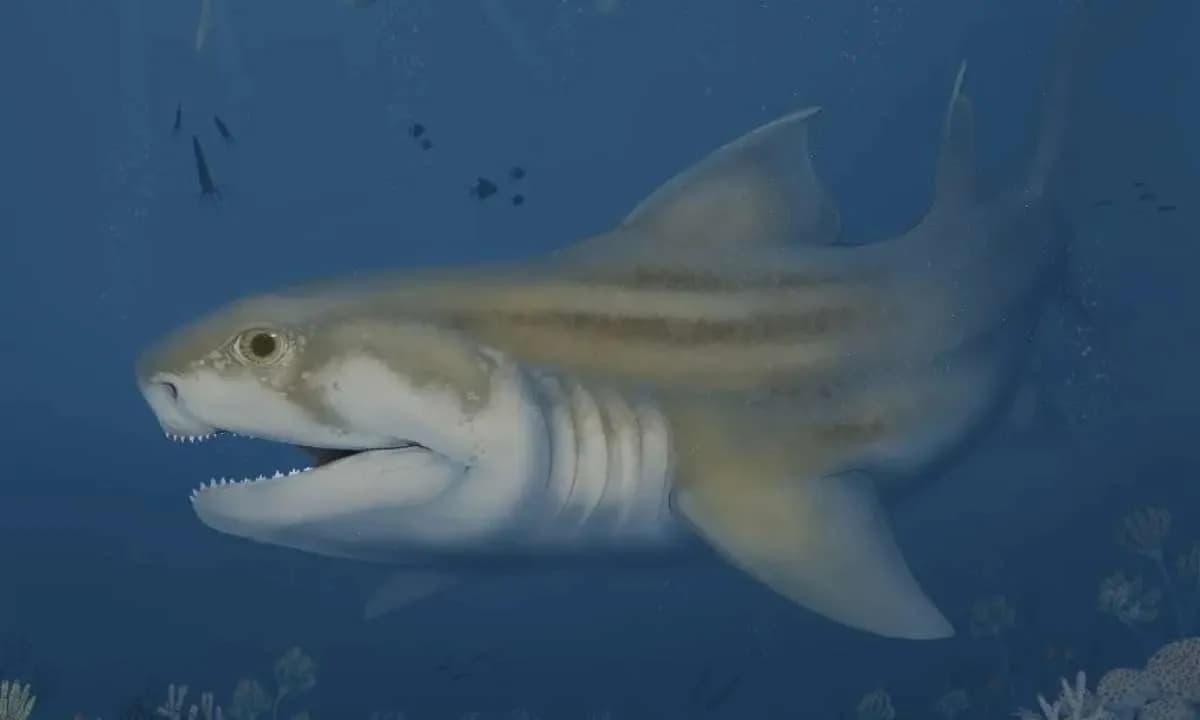
Deep beneath the surface of Kentucky lies a hidden world of ancient secrets, some of which have remained untouched for over 325 million years. In the Mammoth Cave National Park, a recent discovery has left scientists and paleontologists awestruck: the fossils of two previously unknown species of ancient sharks. These sharks, Troglocladodus trimblei and Glikmanius careforum, roamed the seas long before the dinosaurs, patrolling waters that once covered what is now modern-day Kentucky and northern Alabama.
The discovery is not just another fossil find. It opens a window into a world that existed long before humans ever walked the Earth. It gives us a glimpse into the diversity of life that existed when the continents were still separated and long before the supercontinent Pangea formed. The fossils were found in Mammoth Cave, the longest cave system in the world, where more than 70 species of ancient fish have already been identified. But these two sharks are truly exceptional.
Troglocladodus trimblei, a new genus and species of ctenacanth shark, was identified from both adult and juvenile teeth found within the St. Louis and Ste. Genevieve Formations of Mammoth Cave, as well as in the Bangor Formation of Alabama.
The name “Troglocladodus” translates to “Cave Cladodus” or “Cave Branching Tooth,” a nod to the shark’s distinct branched teeth. These sharks, estimated to have been about 10-12 feet long, were active predators, similar in size to today’s oceanic whitetip shark. The shark’s teeth, which resemble tridents, played a key role in its hunting strategy, catching a variety of marine creatures that thrived in the shallow waters of the time.
The second species, Glikmanius careforum, takes the story even further back. This discovery pushes the origins of the Glikmanius genus 50 million years earlier than scientists had previously thought.
The shark was identified primarily from teeth found in the same geological formations at Mammoth Cave and Alabama. But the real surprise came with the discovery of a partial set of jaws and gills of a young Glikmanius — the first cartilage fossil ever found for this genus.
The jaw structure suggests that Glikmanius careforum had a short head with a powerful bite capable of hunting smaller sharks, fish, and squid-like creatures. Like Troglocladodus, these sharks grew to be about 10-12 feet long, similar in size to a modern lemon shark.
The story behind these fossils is one of serendipity and collaboration. The discovery of Troglocladodus trimblei happened by chance when Barclay Trimble, the park superintendent, found the first specimen during a 2019 research trip. While exploring the cave’s complex network of passages, he looked up and spotted a fossil embedded in the ceiling. What seemed like just a simple tooth would eventually lead to the identification of a completely new genus.
Mammoth Cave is an extraordinary natural preservation site. The cave’s stable temperature and its isolation from the outside world have allowed these delicate fossils, including cartilage structures that rarely fossilize, to remain in near-perfect condition. Fossils in Mammoth Cave are often so well-preserved that they look as though they were only recently deposited, which provides scientists with exceptional opportunities to study them in great detail.
But what makes this discovery even more remarkable is the environment in which these sharks once lived. Over 325 million years ago, the region that is now Kentucky was submerged under a warm, shallow sea, teeming with marine life. This sea connected what is now North America, Europe, and northern Africa, a time when the Earth was experiencing massive geological shifts. As the continents slowly drifted and eventually formed the supercontinent Pangea, these ancient seas disappeared, but the fossilized remains of their creatures remained, preserved in the limestone of Mammoth Cave.
These findings are part of the ongoing Paleontological Resources Inventory (PRI), which began in 2019 when ancient shark specialist John-Paul Hodnett joined forces with the National Park Service Paleontology Program to study Mammoth Cave’s shark fossils. The PRI has already led to the identification of over 70 different species of ancient fish found in the cave’s extensive network of passages.