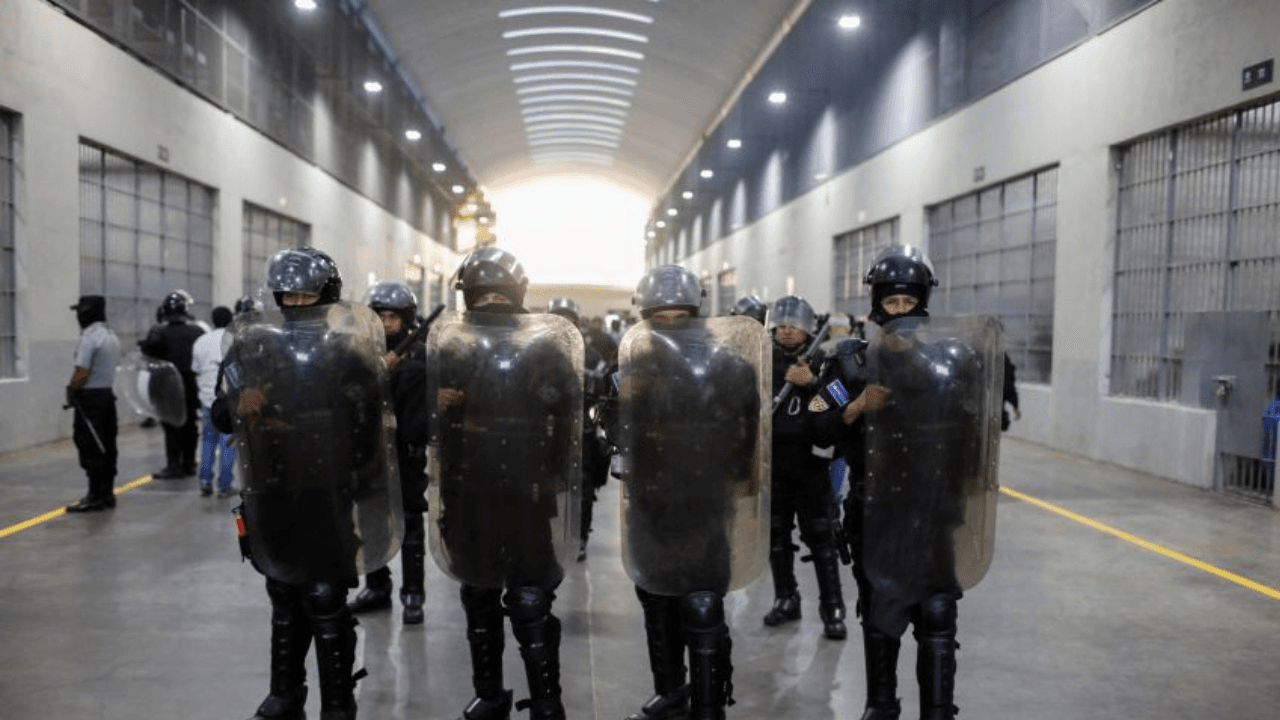
President Donald Trump promoted El Salvador’s CECOT prison, claiming deportations there helped reduce U.S. crime amid documented abuse allegations.
In a Truth Social post reported on October 14, 2026, Trump shared footage associated with deportations and the maximum-security facility. He credited the policy with bringing murder and other crimes to record lows, according to LADbible’s account of the post.
That claim does not establish that transfers to CECOT caused a nationwide decline. Assessing it would require comparable crime data and evidence separating the policy’s effects from other factors.
What Is CECOT?
The Centro de Confinamiento del Terrorismo, commonly known as CECOT, is a maximum-security prison in El Salvador designed to hold approximately 40,000 people.
The facility has become a prominent part of Salvadoran President Nayib Bukele’s crackdown on gangs. Its heavily controlled environment and treatment of detainees have also drawn international scrutiny.
Descriptions such as “the worst prison on earth” are characterizations, not an independently established ranking.
Who Was Sent There From the United States?
Human Rights Watch and the regional rights organization Cristosal documented the transfer of 252 Venezuelan nationals from the United States to CECOT in March and April 2025. The group included asylum seekers.
Their November 2025 investigation found that roughly half had no criminal history. Only 3 percent had U.S. convictions for violent or potentially violent offenses, the organizations reported.
These were Venezuelan nationals deported from the United States, not a group of U.S. citizens transferred abroad to serve American prison sentences. Deportation itself also does not establish a criminal conviction.
Rights Groups Reported Torture and Other Abuse
Human Rights Watch and Cristosal reported repeated beatings, degrading treatment, inadequate food and limited medical care. Some former detainees also reported sexual violence.
Researchers interviewed 40 former detainees and reviewed supporting material, including injury photographs and records. The organizations concluded that the abuses were systematic rather than isolated.
They said U.S. and Salvadoran authorities did not respond to their requests for information before publication.
Release Is Different From Escape
In July 2025, El Salvador returned the 252 Venezuelans to Venezuela as part of an exchange involving 10 U.S. citizens or permanent residents held there.
That transfer was a negotiated release, not an escape. It also means that claims suggesting nobody ever leaves CECOT alive are misleading.
Trump’s promotion of the prison brings renewed attention to both his deportation policy and the treatment of people sent abroad. The central questions remain distinct: who was transferred, what legal process they received, how they were treated and whether the transfers measurably affected U.S. crime.