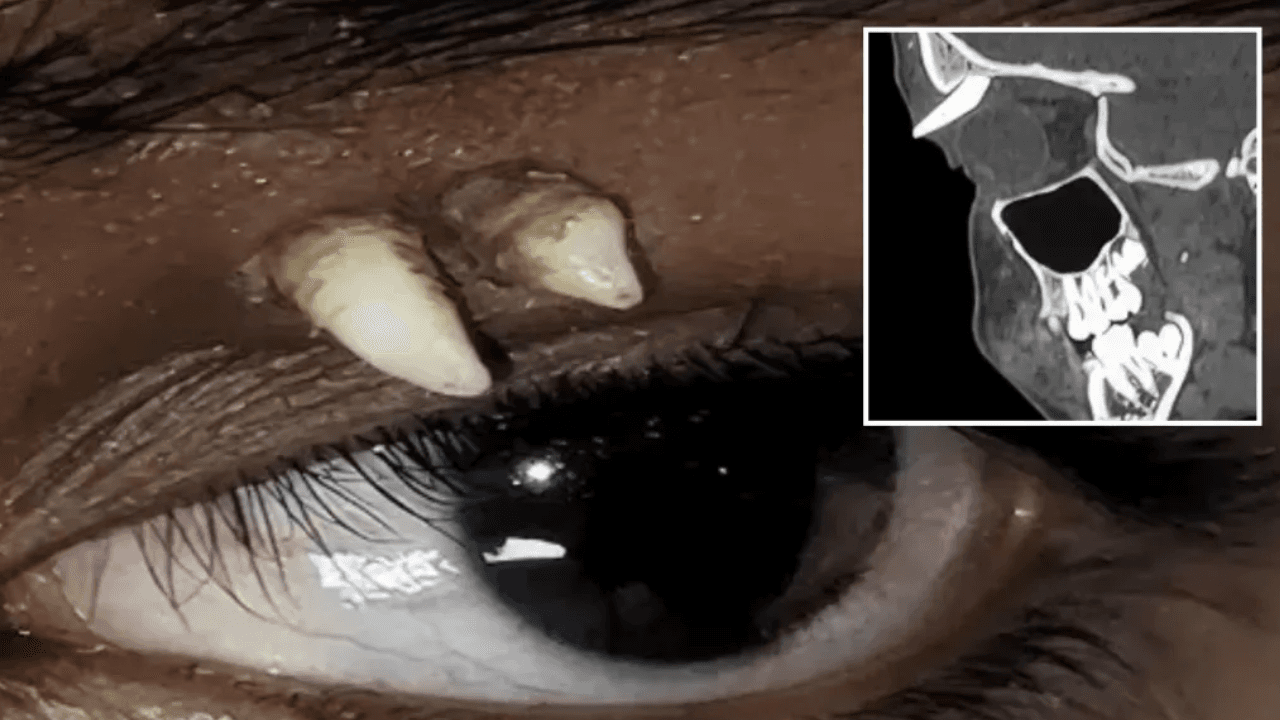
For months, a 16-year-old boy in India noticed something unusual above his left eye. His upper eyelid was swollen, but it did not hurt.
Then two hard, white points began to emerge from the skin between his eyelid and eyebrow.
When doctors at Aravind Eye Hospital in Madurai examined him, they considered several explanations. The answer on his CT scan was something they had never encountered in that location before.
A fully formed canine tooth was growing in the upper part of his eye socket.
Two White Points Appeared Above His Eye
The teenager had lived with painless swelling around his left upper eyelid. Roughly a month before he visited the hospital, he noticed two whitish projections.
They were hard to the touch and had fairly smooth surfaces.
He had no reported history of an injury that could explain the swelling. Because the area was close to his eye, the unusual growth needed careful investigation.
Doctors considered whether the projections might be a foreign object or part of a teratoma. A teratoma is a type of tumor that can contain several kinds of tissue, sometimes including teeth or bone.
But they could not make a diagnosis from the appearance alone.
A CT Scan Revealed a Canine Tooth
Doctors ordered computed tomography, commonly called a CT scan, to examine the upper eye socket.
The images showed a dense structure with the shape of a tooth, including a crown and a root.
It appeared to arise from the roof of the left orbit, the bony cavity containing the eye. Part of the structure extended toward the eyelid and protruded through the skin.
The unusual location made the discovery especially significant.
In the medical case report, doctors Meghana Tanwar, Vedant Sharma and Usha Kim described what appeared to be a mature canine tooth outside the mouth.
What Is an Ectopic Tooth?
An ectopic tooth is a tooth that develops or erupts somewhere outside its usual position.
Some teeth grow in the wrong place within the mouth. Much rarer cases involve teeth appearing outside the dental arch altogether.
Doctors have documented ectopic teeth in parts of the nose, jaw, palate and the maxillary sinus, an air-filled space near the cheekbone.
But this teenager's tooth was in the superior orbit, or upper eye socket.
Dr. Tanwar told Live Science that, to the team's knowledge, it was the first reported case of a lone ectopic tooth in that location.
This does not mean teeth have never been found near an eye before. Rather, the case involved an unusually high position in the orbit.
Surgeons Removed the Tooth
The team performed surgery to remove the abnormal structure.
The removed object was a mature canine tooth. Examination found no teratomatous elements, meaning there was no evidence that the tooth formed part of a teratoma.
The case was therefore diagnosed as an ectopic canine tooth of the superior orbit.
According to additional reporting on the case, the teenager recovered without complications. Doctors indicated that the tooth had primarily caused a cosmetic concern rather than interfering with the eye's function.
Its location could have posed problems if it had pressed on nearby muscles, nerves, blood vessels or the eye itself.
How Could a Tooth Develop Near an Eye?
The exact reason a tooth developed in this teenager's upper orbit remains unknown.
Teeth form through a complex series of interactions between developing tissues before birth.
If that process is disrupted, tooth-forming cells may occasionally develop in an unusual location.
Other possible explanations discussed in medical literature include developmental abnormalities, cysts, tumors, injuries and, in some cases, inherited conditions.
Those are general explanations for ectopic teeth. Doctors did not identify a specific cause in this patient's case.
Why Doctors Called the Case a First
The discovery attracted attention because the affected area was so unusual.
Teeth have previously been reported in the lower orbit and surrounding facial structures. The upper orbit, however, was not a recognized location for a solitary ectopic tooth in the published cases known to the team.
The medical report, titled Ectopic Canine Tooth in the Superior Orbit, was published online in January 2026 and appeared in the June 2026 issue of Ophthalmology.
Its authors were Dr. Meghana Tanwar, Vedant Sharma and Dr. Usha Kim of Aravind Eye Hospital.
The report shows why careful imaging matters: what looked like an unexplained eyelid growth was actually a recognizable tooth in an extraordinary position.
A Rare Discovery With a Successful Outcome
For the teenager, the swelling began as a painless problem that was easy to ignore.
The appearance of two white points led him to seek medical care. A scan provided the answer, and surgery removed the tooth.
The case is a reminder that unexpected symptoms can have equally unexpected explanations.
What appeared to be a mysterious growth above his eye turned out to be a canine tooth—one in a location doctors had never previously documented in this form.
The patient's name was not disclosed in the medical report. This article describes a case published in 2026; it should not be treated as general medical advice.
Sources: Ophthalmology — original medical case report; PubMed — study details; Live Science — interview with Dr. Tanwar; mivision — surgical outcome.