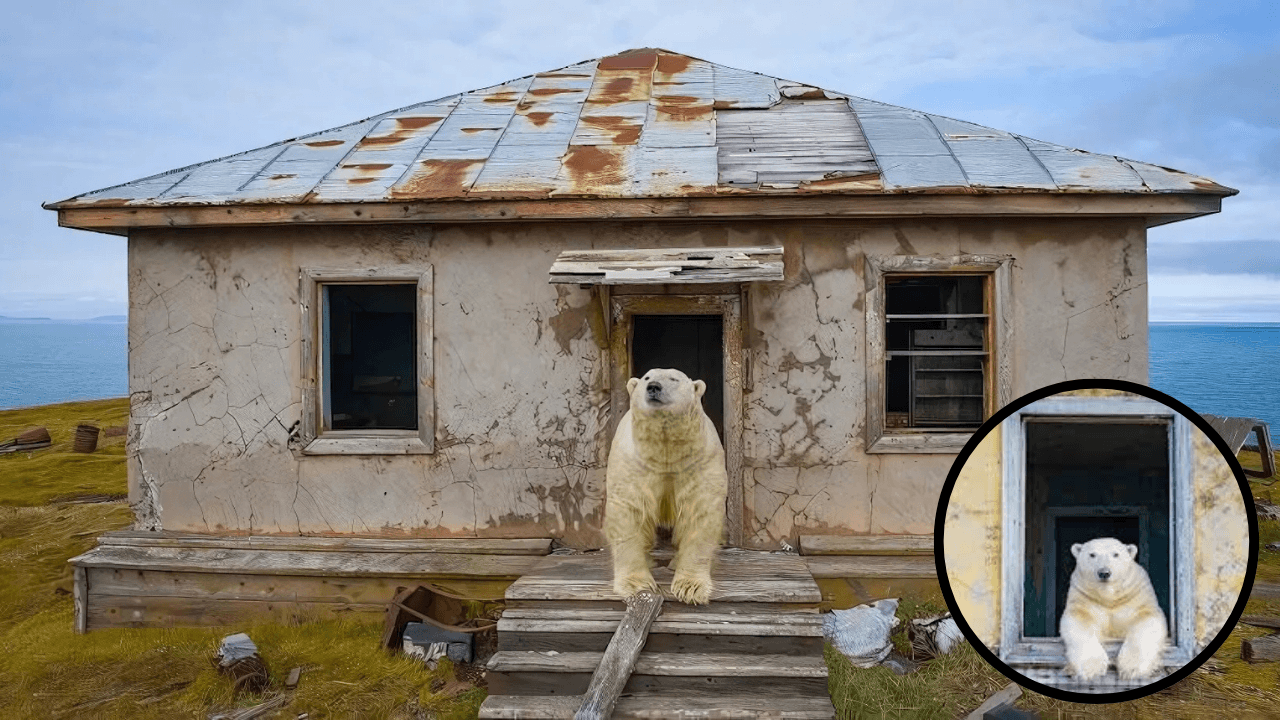
A small Arctic island, once mapped and monitored by Soviet meteorologists, now has some surprising new tenants. Drone footage revealed a family of polar bears living inside the crumbling weather station on Kolyuchin Island, and the video quickly spread around the world. What was once a silent outpost for humans has turned into a shelter for the very creatures most affected by the Arctic’s shifting climate.
The story begins decades ago when the Soviet Union established a weather station on Kolyuchin Island, a remote piece of land in the Chukchi Sea. These stations were vital for charting Arctic conditions during the Cold War era. But as time passed, the station was abandoned. Its peeling walls, broken windows, and rusting equipment stood as a ghostly reminder of human presence in one of the most isolated places on Earth.

Today, those same structures are more than relics. They offer polar bears protection from howling winds, snowstorms, and even other bears. The viral footage shows cubs cautiously stepping out from a dark doorway, with their mother close behind. Inside, wallpaper still clings to the walls, making the scene both haunting and strangely familiar—wild predators moving through what looks like someone’s old home. The contrast between wild bears and human interiors is what made the video so powerful to watch and so easy to share.

Why are the bears there at all? The Arctic is warming nearly four times faster than the global average. As sea ice shrinks and forms later each year, bears are forced to stay on land longer. They spend more time near abandoned settlements, scavenging and searching for safe shelter. Kolyuchin’s weather station, empty for decades, became the perfect refuge. It is not common for polar bears to move into buildings, but in recent years similar reports have surfaced in other parts of the Arctic. This behavior shows just how much their survival strategies are shifting.
The drone that captured the footage gave viewers a rare perspective. The aerial shots glide silently over the empty roofs before zooming in on doorways where the bears appear. But there is an important detail behind such striking images: flying drones around wildlife must be done responsibly. Conservation groups warn that bears can become stressed or agitated if approached too closely. Ethical operators keep their distance and monitor signs of distress to avoid interference.
Video featuring drone footage of a family of polar bears that moved into an abandoned weather station on Kolyuchin Island a few years ago and have now settled in.
byu/MilesLongthe3rd ininterestingasfuck
The scene also raises a larger question: what do these ghost stations and polar bear shelters say about the world we are leaving behind? Abandoned outposts still scatter across the Arctic, many rusting into the tundra. While humans may have left, wildlife is reclaiming these spaces. For polar bears, this is both a story of resilience and a sign of struggle. They are adapting, but only because the ice that once supported their survival is disappearing.

Kolyuchin Island itself remains off-limits for most people. It is uninhabited, remote, and not served by regular transport. That isolation is part of what makes the footage so compelling. It feels like a secret glimpse into a world rarely seen, where the past and present collide—the ruins of human exploration turned into a safe haven for Arctic giants.
The haunting image of a cub peeking from a darkened doorway is more than a viral clip. It captures how climate change, human history, and wildlife survival now overlap in unexpected ways. The weather station may have fallen silent, but in its place, the Arctic’s most iconic predator has made a temporary home. For viewers, it is a reminder of how quickly the world is changing, and how even the most remote corners are part of that story.
Disclosure: We may earn a commission when you make a purchase through the ads.