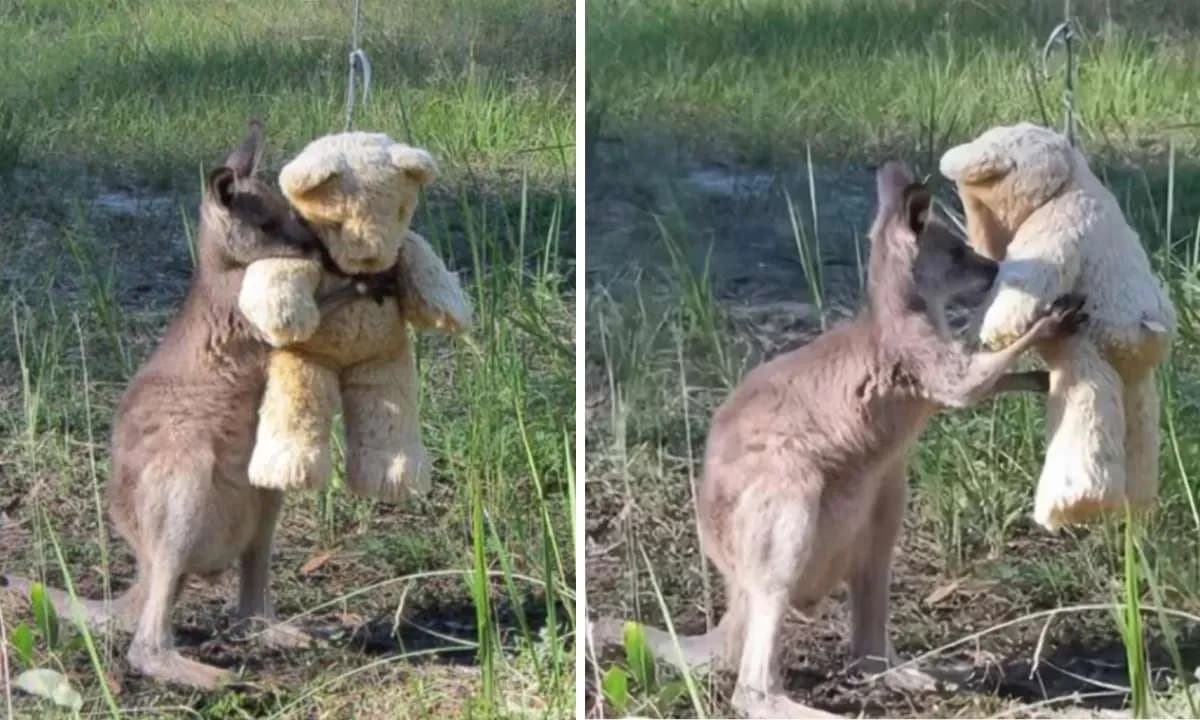
In the forests of northern New South Wales, Australia, a tiny eastern grey joey named Doodlebug faced life alone much too early. He was just three and a half pounds when found on the side of the road near Grafton. No one knew exactly why he had been abandoned. His mother may have been struck by a car, attacked by a dog, or perhaps she had left him behind. What was certain was that the joey would not survive on his own.
That’s when Gillian Abbott, a retired worker who devotes her spare time to caring for orphaned and injured animals on her forested property, stepped in. Abbott has been rescuing kangaroo and wallaby joeys for years and has released more than 35 back into the wild. When she took in Doodlebug, she knew he would need more than food and shelter. Baby kangaroos depend heavily on their mothers’ pouches, not just for safety but also for comfort and emotional security.
To fill that gap, Abbott created a simple but effective solution. She hung teddy bears at pouch height inside Doodlebug’s enclosure. These soft toys served as substitutes for the mother’s presence. For the young joey, the teddy became more than just an object—it was a source of comfort, a stand-in for the warmth and safety he had lost.
Doodlebug immediately bonded with his teddy. He wrapped his arms tightly around it, lay in the grass beside it, and even practiced his playful kicks against it—behaviors he would normally share with his mother or another kangaroo. Abbott described it as enrichment, a way to give him company when she could not always be there. “It’s like mum is always standing beside him,” she explained, “and teddy fulfills a huge role in his life.”
As Doodlebug grew, Abbott prepared him for a “soft release.” This meant that the gates of his pen remained open so he could roam into the bush freely, learning to live on his own. Yet he could always return for food or comfort whenever he wished. Even after tasting freedom, Doodlebug often came back—not only to eat, but also to reconnect with the teddy that had become his emotional anchor.
The story might have stayed local, but Abbott’s son, Tim Beshara, shared a photo of Doodlebug hugging his teddy on Twitter. Tim, who works as a political adviser, captioned it: “My mum (a wildlife-carer) sent me this. Showing the value of a good hug, especially for an orphaned wallaby.” The image struck a chord instantly. It was shared thousands of times, featured in international news outlets, and even broadcast on television.
What was meant as a sweet family photo became a viral moment. People around the world were moved by the sight of a small kangaroo clinging to a teddy bear as if it were his mother. For Abbott, the global attention was unexpected but welcome. She felt joy that her “little boy” had made so many people happy and hoped that the attention might also encourage more awareness and support for wildlife care.
Doodlebug’s story is more than just a cute photo on the internet. It is a glimpse into the challenges of raising orphaned wildlife and the creative ways carers provide for their needs. For Abbott, the hard work is worth it when she sees the animals she raises return to the bush, free and independent. And for the millions who saw the viral photo, it was a reminder of something universal—that comfort, security, and connection are not only human needs but something that every living creature longs for.
Sometimes, love comes in the shape of a stuffed bear.
Disclosure: We may earn a commission when you make a purchase through the ads.