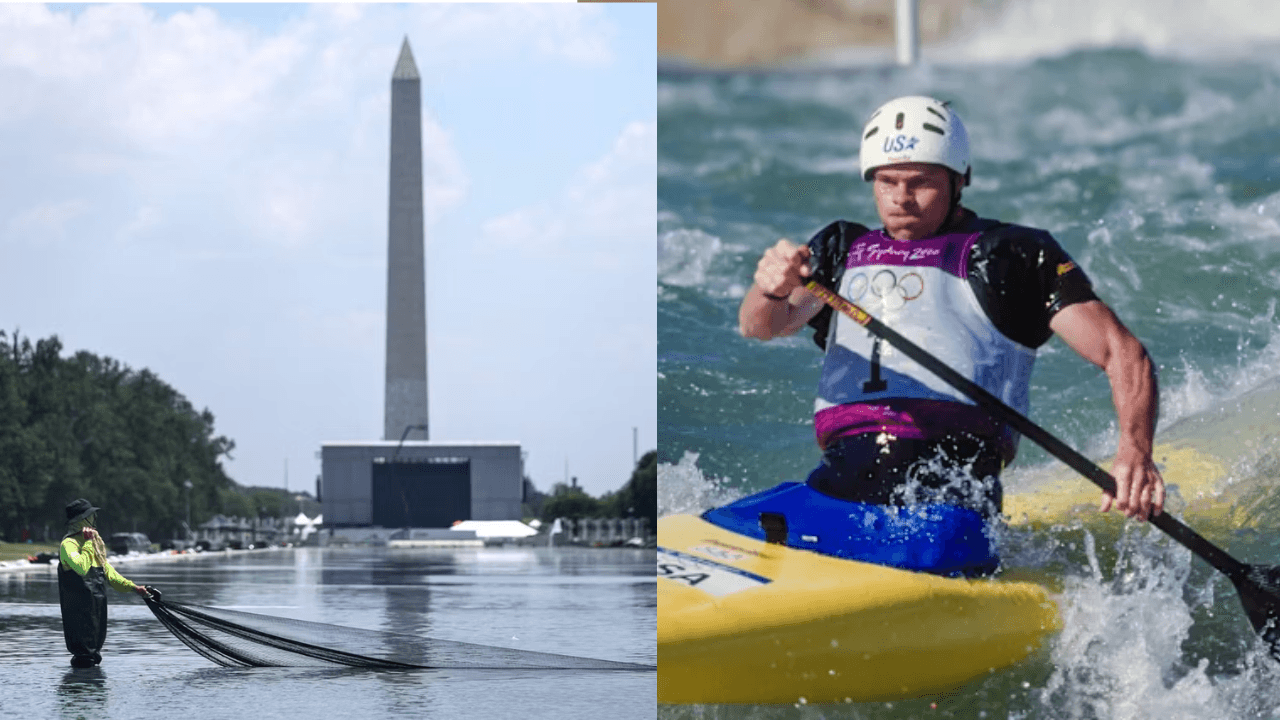
Former U.S. Olympic canoe racer David Hearn was indicted Thursday, July 2, 2026, on a felony property destruction charge tied to the Lincoln Memorial Reflecting Pool.
Hearn was charged in Washington, D.C., court with one count of property destruction.
Prosecutors say he damaged newly installed sealant at the bottom of the pool on June 19. Hearn has denied damaging the pool.
D.C. U.S. Attorney Jeanine Pirro said Hearn caused more than $1,000 in damage by pulling up part of the pool’s bottom liner.
Pirro said National Park Service employees saw Hearn pulling at the liner with both hands and that an employee told him to stop.
The felony threshold matters because D.C. law treats malicious destruction of property worth $1,000 or more as a crime that can carry up to 10 years in prison.
Hearn previously said he reached into the water because he wanted to examine the peeling blue coating.
He said he briefly touched a loose piece that was still attached and stopped after a park worker told him to stop.
His lawyers, Norm Eisen and Mary Dohrmann, said Hearn is innocent and called the charges outrageous. They argued the case is being used to shift blame for problems with the pool renovation.
The indictment comes after President Donald Trump blamed vandals for damage to the pool following a renovation project ahead of America’s 250th anniversary.
The project added a blue coating that Trump called “American flag blue.” But the pool later faced algae growth, peeling coating and public criticism.
Trump claimed, without providing public evidence, that vandals dumped fertilizer in the water and cut the coating with a box cutter.
Pirro said prosecutors are reviewing about a half-dozen other cases connected to alleged Reflecting Pool vandalism.
Some could be misdemeanors or lesser violations, she said.
Hearn’s case is the first felony indictment publicly tied to the pool damage dispute.
The Lincoln Memorial Reflecting Pool sits inside National Mall and Memorial Parks, which the National Park Service calls “America’s Front Yard.”
The site has long been tied to national memory, protest and celebration. That history has made the current dispute more politically charged.
For prosecutors, the case is about alleged damage to public property. For Hearn’s defense, it is about whether an ordinary act of curiosity has been turned into a felony case.
Hearn has not been convicted of any crime. The charge now moves into court, where prosecutors will have to prove the allegation beyond a reasonable doubt.