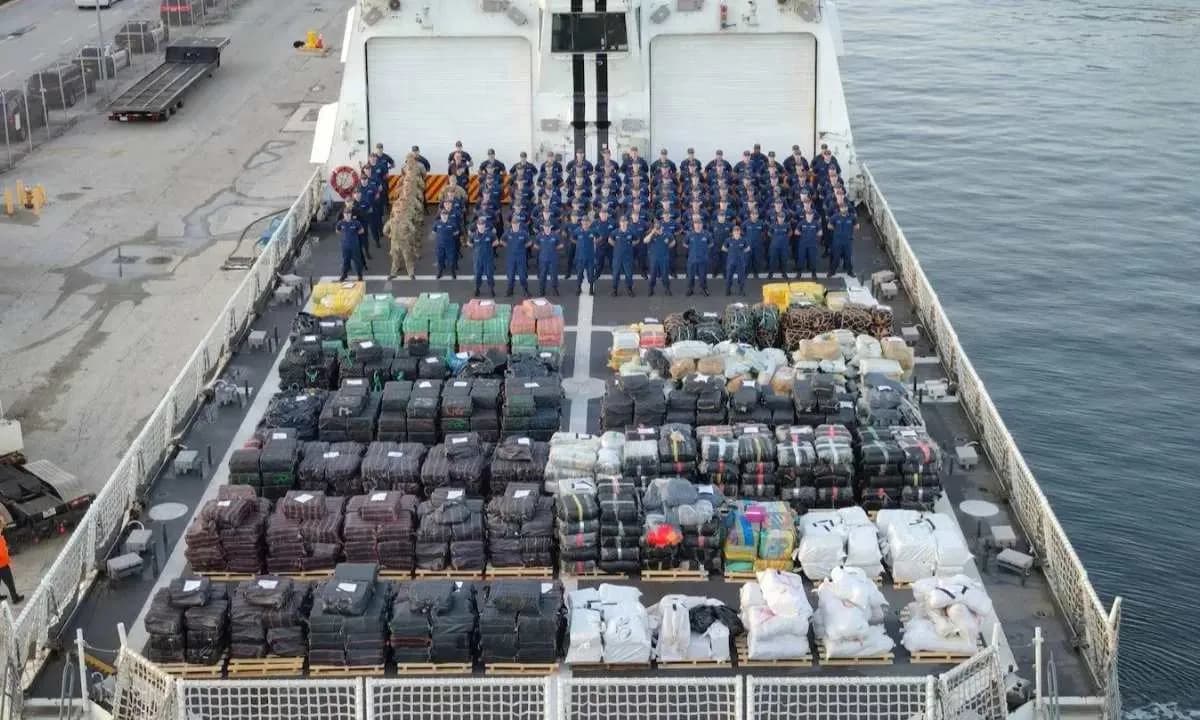
On a hot Monday morning in Port Everglades, Florida, a Coast Guard cutter pulled into dock carrying a sight that stunned the nation: the largest drug offload in the service’s 110-year history. Crew members from the Coast Guard Cutter Hamilton stood in formation as cranes lifted pallet after pallet of tightly wrapped bales.
By the end of the day, more than 76,000 pounds of illegal drugs had been transferred from the ship to secure facilities. The haul included about 61,740 pounds of cocaine and 14,400 pounds of marijuana. Officials estimated the street value at $473 million.
The scale of the seizure is almost hard to imagine. With a lethal dose of cocaine being as little as 1.2 grams, the amount recovered was enough to deliver 23 million potentially fatal doses—roughly the entire population of Florida.
Admiral Kevin Lunday, acting commandant of the Coast Guard, emphasized that this record-breaking offload was more than just numbers. It was proof of Operation Pacific Viper, a new mission designed to stop drug and human smuggling before it ever reaches U.S. shores.
This operation, which began in late June, stretched across the eastern Pacific Ocean and Caribbean Sea. Over two months, Coast Guard teams carried out 19 interdictions in international waters. Each one involved high-speed pursuits of “go-fast” vessels, boarding actions, and in some cases, coordinated airborne use of force.
The missions weren’t carried out by the Coast Guard alone. U.S. Navy destroyers, the Dutch Navy, Customs and Border Protection aircraft, and interagency task forces all played a part. Together, they formed a network of eyes in the sky and ships on the water, tightening the net around transnational cartels.
Some interdictions stood out for their scale. Near Socorro Island, Mexico, Coast Guard teams seized over 9,000 pounds of cocaine in a single bust—about 12% of the entire summer’s haul. Off the coast of Venezuela, another joint effort captured more than 5,000 pounds. And near the Galapagos Islands, a series of back-to-back chases netted over 13,000 pounds of cocaine in just a few days. These seizures weren’t just random chance. They were the product of intelligence work and international coordination, designed to cut off trafficking routes at sea.
By the time Hamilton reached Florida, its crew had personally interdicted 11 go-fast vessels and detained 34 suspected smugglers. Rear Admiral Adam Chamie, commander of the Coast Guard’s Southeast District, praised the crew’s grit.
“These men and women put themselves in harm’s way time and again,”
Rear Admiral Adam Chamie said.
“This is grueling and dangerous work.” Captain John B. McWhite, commanding officer of Hamilton, echoed the sentiment, calling the achievement the result of months of sacrifice not just by the sailors, but also their families back home.
The Coast Guard made clear that the impact goes beyond the sheer weight of the narcotics. Every bale offloaded represents money denied to cartels and a blow to the networks that fuel violence, corruption, and even the production of fentanyl. Officials stressed that the operation also provides valuable evidence and intelligence for ongoing investigations into the highest-level criminal organizations.
Homeland Security Secretary Kristi Noem and President Trump have both framed Operation Pacific Viper as a cornerstone of the U.S. strategy against foreign cartels, a campaign meant to project overwhelming force on the seas.
As the pallets of drugs stacked up at Port Everglades, the scene became a symbol: not only of the scale of the smuggling challenge but also of what’s required to fight it. The Coast Guard says 80% of drug interdictions happen on the high seas, where cooperation with allied navies and U.S. agencies is essential. Each interdiction begins with a sighting from aircraft or drones and ends with Coast Guard boarding teams confronting traffickers head-on, often hundreds of miles from shore.
The record offload is being called a milestone, but officials are quick to say it’s only one chapter in a longer story. Cartels are constantly adapting, shifting routes, and finding new ways to move product north. That means the Coast Guard and its partners will keep accelerating their operations in the Pacific and Caribbean. For now, though, the Hamilton’s massive haul is being remembered as a defining moment—a vivid reminder of the invisible battles being fought at sea to keep drugs off American streets.