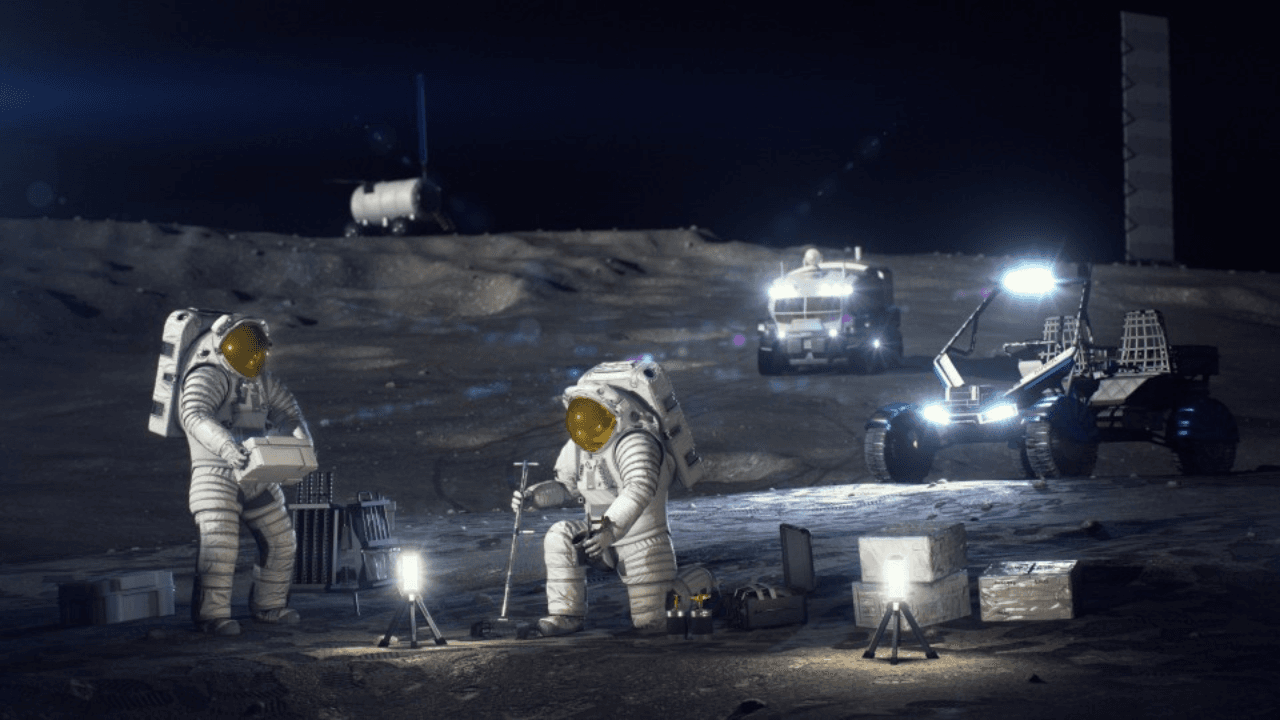
NASA moon base plans now include landers, rovers, drones, and a long term human foothold near the lunar south pole.
NASA has unveiled the first phase of its plan to build a permanent base on the moon, marking one of the agency’s biggest steps yet toward keeping humans on the lunar surface for long periods.
The project will begin with robotic landers, moon buggies, science tools, and drones near the lunar south pole. NASA says these early missions will help test the systems astronauts need before the agency builds larger permanent infrastructure.
The announcement came from NASA headquarters in Washington, D.C., as the agency moved forward with its Artemis campaign. The effort aims to return astronauts to the moon, build a lasting American presence there, and prepare for future missions to Mars.
NASA’s official Moon Base phase plan says Phase One will include up to 25 missions, including 21 landings, as well as rovers, drones, communications systems, and early power demonstrations. NASA says the first phase will deliver about four tons of payload to test what works on the lunar surface. More details are available on NASA’s Moon Base phases page.

Blue Origin Will Help Start the Lunar Base Buildout
Blue Origin, the space company founded by Jeff Bezos, will play a key role in the early phase. NASA says Blue Origin’s Blue Moon Mark 1 lander, also called Endurance, will deliver science investigations and test technologies needed for future lunar operations.
The uncrewed lander will support NASA’s Commercial Lunar Payload Services program. It will test precision landing, cryogenic propulsion, and autonomous guidance, navigation, and control, according to NASA.
Reuters reported that NASA awarded Blue Origin a 188 million dollar contract to use its Mark 1 cargo lander to deliver rovers to the moon’s surface. NASA also awarded Astrolab 219 million dollars and Lunar Outpost 220 million dollars to build and deliver lunar terrain vehicles.
Those vehicles matter because astronauts will need mobility to work across the lunar south pole. The south pole has drawn major interest because some permanently shadowed craters may hold water ice, a resource that could support future crews.

Rovers and Drones Will Scout the Moon First
NASA’s first phase is not just about landing hardware. It is about learning how to move, map, power, and protect a base in one of the harshest places humans have ever tried to operate.
Astrolab and Lunar Outpost will produce new lunar terrain vehicles. These rovers will help NASA test astronaut mobility, cargo movement, and autonomous surface operations.
NASA also plans to use MoonFall drones near the lunar south pole. The drones will help explore and map rough terrain, which could support landing site planning, communications, and future construction.
Firefly Aerospace was selected to build the spacecraft that will carry drones from Earth orbit to the moon for the MoonFall mission, which Reuters reported is targeted for launch in 2028.

NASA Wants a Base That Spreads Across a Vast Area
The long term vision is much larger than a single habitat. NASA Moon Base program executive Carlos Garcia-Galan has described a base that could spread across hundreds of square miles.
That does not mean NASA plans to build a city of skyscrapers on the moon. Instead, the base would likely include landing zones, power systems, habitats, rovers, communications equipment, science stations, and drone marked operating areas across a wide region.
The Associated Press reported that Garcia-Galan envisions the moon base sprawling over hundreds of square miles, with MoonFall drones marking the perimeter. NASA Administrator Jared Isaacman said those markers are meant to respect other nations’ spacecraft and equipment nearby.
The goal is to create a working lunar zone where astronauts and robots can operate together. That would help NASA study the moon, test survival systems, and build experience for future Mars missions.

Artemis Missions Remain the Human Side of the Plan
The Moon Base effort is tied directly to Artemis, NASA’s program to return astronauts to deep space. Artemis II recently sent astronauts around the moon, while later missions will test landers and prepare for surface operations.
AP reported that NASA is targeting Artemis III for mid 2027 as a mission to practice docking NASA’s Orion spacecraft with lunar landers in Earth orbit. A crewed moon landing by two astronauts could follow as soon as 2028. :contentReference{index=4}
NASA says the second phase of the moon base plan, starting in 2029 and moving into the early 2030s, will focus on permanent infrastructure, including a power grid. The third phase in the 2030s aims to support longer astronaut stays in specialized habitats.
That timeline makes the early robotic missions important. Every lander, rover, and drone gives NASA more data before people live and work on the surface for extended periods.

The Moon Base Is Also About Mars
NASA has framed the moon base as more than a return to Apollo style exploration. The agency wants the moon to become a training ground for deeper space missions.
Living on the moon would teach engineers how to handle dust, radiation, extreme cold, long nights, limited supplies, and delayed rescue options. Those lessons could shape how humans later travel to Mars.
NASA’s Artemis campaign page says the agency will use the moon to learn how to live and work on another world before sending astronauts farther into the solar system. More information is available from NASA’s Artemis program page.
Isaacman said NASA sees the base as a way to encourage a lunar economy while conducting science and preparing for Mars. “For those waiting patiently, the grand return is close at hand and we will not slow down,” he said, according to AP.
A Permanent Human Foothold Is Still Years Away
NASA’s plan is bold, but it will not happen all at once. The first phase focuses on proving that landers, rovers, drones, power systems, and science tools can work together near the lunar south pole.
The larger permanent base will depend on future missions, funding, contractors, launch schedules, and successful tests on the moon. Space programs often face delays, especially when they involve new vehicles and human spaceflight.
Still, the new contracts show NASA is moving from concept to hardware. Blue Origin, Astrolab, Lunar Outpost, Firefly Aerospace, and other partners are now part of a push to build the first real human operating zone beyond Earth.
If the plan holds, the next decade could mark a turning point in space history. The moon would no longer be only a place humans visited for a few days. It could become the first place beyond Earth where people learn how to stay.