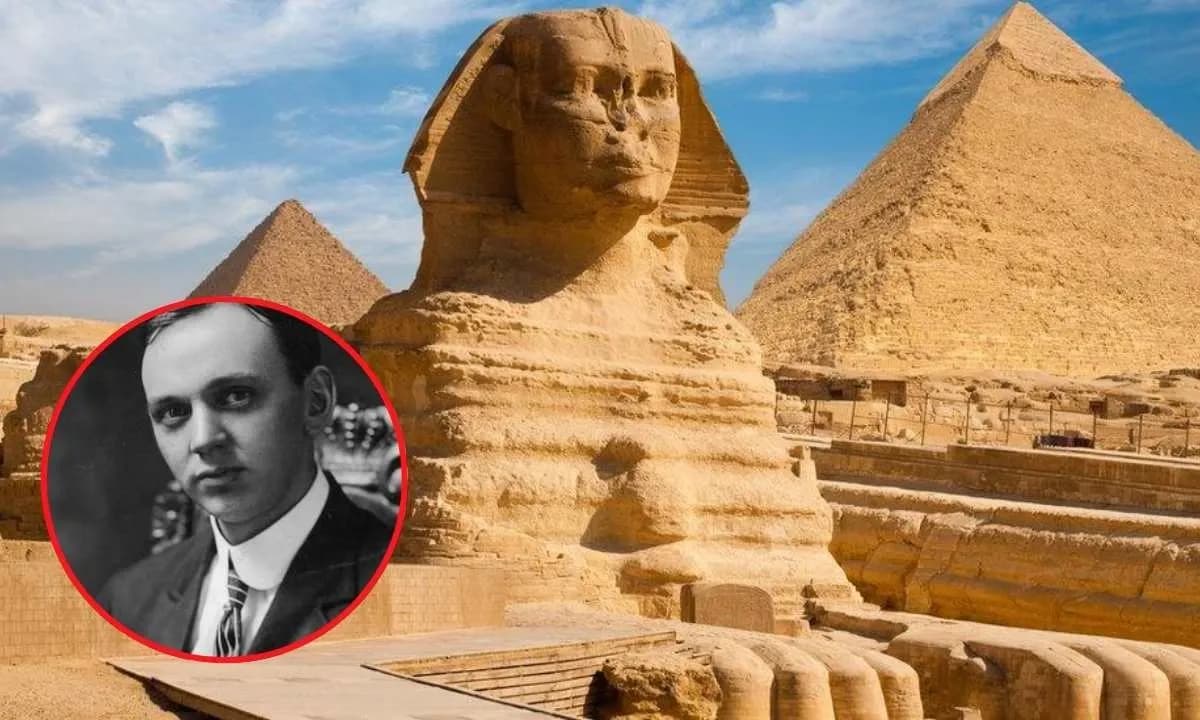
In 1932, a man named Edgar Cayce made a strange prediction. He said that underneath the right paw of the Great Sphinx in Egypt, there was a hidden passage. That passage, he claimed, led to a secret chamber called the Hall of Records—a room filled with knowledge from the lost civilization of Atlantis.
For years, Cayce’s claim was dismissed as fantasy. After all, he wasn’t a scientist—he was a clairvoyant who gave readings while in a trance. But almost a century later, something unexpected happened. A team of researchers from Italy and the UK announced that they had used radar technology to detect deep underground chambers beneath the Sphinx—just as Cayce had described.
This team, led by Filippo Biondi and Corrado Malanga, believes they’ve discovered a complex network of vertical shafts, spiral staircases, and chambers stretching as deep as 4,000 feet beneath the Giza Plateau. One chamber lies about 2,000 feet deep, and another double that. According to their data, this underground world could extend over 6,500 feet—far larger than the pyramids above it.
The researchers presented their findings at the Cosmic Summit in North Carolina, a conference known for unusual theories about ancient history. Their work, called the Khafre Project, used pulse radar scanning to analyze what lies beneath the surface. This technology, similar to sonar used to map ocean floors, sends radar waves into the ground and reads the signals that bounce back. The images revealed what the researchers described as vertical cylindrical wells, chambers, and even what appears to be a water system running beneath the pyramids.
They went a step further. The team said these underground structures might be linked to the so-called Hall of Records—the very chamber Edgar Cayce described in his readings nearly 100 years ago.
But not everyone is convinced.

Experts in archaeology and radar technology have raised serious doubts. Lawrence Conyers, a professor at the University of Denver, says the idea of radar revealing structures 4,000 feet below ground is simply not possible with current technology. He called the claim of an underground city “a huge exaggeration,” though he acknowledged that smaller cavities or features might exist under the pyramids—something seen in other ancient cultures like the Mayans, who often built pyramids over caves.
Egypt’s top archaeologists have also spoken out. Dr. Zahi Hawass, a leading authority on the Sphinx and pyramids, strongly rejected the findings. He emphasized that no scientific research had been approved or conducted at the site by the Egyptian government. Another expert, Mamdouh al-Damaty, a former Minister of Antiquities, dismissed the claims as baseless and unsupported by decades of real archaeological work.
Egyptologist Hussein Abdel-Basir added that the study lacked proper scientific standards, noting that no peer-reviewed research had been published—only a press conference and radar images.
Despite the controversy, the discovery stirred global curiosity. For believers in Cayce’s predictions and the story of Atlantis, the idea that something could be buried beneath the Sphinx feels too real to ignore.
The legend of the Hall of Records goes back far beyond Cayce. Stories about hidden passages beneath the Sphinx and the pyramids date to Roman times, Islamic legends of a pre-flood Egyptian king, and 19th-century explorers who believed in a vast network of tunnels under Giza. But it was Cayce who brought the story into modern attention. He claimed the Hall of Records was built by survivors of Atlantis to preserve their knowledge, and that it would be discovered during a time of great change in the world.
Throughout the 1990s, interest in this theory exploded. Cayce’s supporters teamed up with scientists to scan the bedrock near the Sphinx. One study even claimed to find a chamber beneath the right paw, but later drilling showed only natural rock. Still, Cayce’s ideas inspired a wave of books, documentaries, and research tying the Sphinx to advanced ancient civilizations and theories about astronomical alignments and forgotten history.
Meanwhile, real discoveries have been made at Giza. In 2024, scientists found a 40-mile-long buried branch of the Nile River, which likely helped transport giant stones during the pyramids’ construction. Archaeologists like Mark Lehner and Zahi Hawass have spent decades studying the Sphinx and its surrounding structures. Their findings suggest the Sphinx was built by Pharaoh Khafre about 4,500 years ago. It was carved from a single mass of limestone, and the blocks removed were likely used to build nearby temples.
They also discovered a massive workers’ village nearby, home to thousands of laborers who may have helped build the pyramid complex and the Sphinx. These workers weren’t slaves, as once believed, but skilled people fed on prime beef and likely took shifts in a kind of national labor service.
Lehner’s research revealed fascinating things about the Sphinx’s design. At sunset on the spring and fall equinoxes, the sun appears to sink directly behind the statue into Khafre’s pyramid. From another angle, the sun sets between the pyramids of Khufu and Khafre, forming a symbol known in ancient Egyptian writing as the akhet, which means horizon and represents rebirth. This suggests the entire complex may have been designed as a massive sacred machine, built to connect the pharaoh’s soul with the sun god Ra.
Even if the so-called underground city is never proven, the Sphinx continues to surprise researchers. Its original name, meaning “Horus-in-the-Horizon,” wasn’t known until an inscription on a granite slab told the story of Thutmose IV, a young prince who dreamed the Sphinx spoke to him and offered him the throne if he would clear away the sand burying its body.
That sand buried the Sphinx up to its neck for most of its life. The statue has been restored many times over thousands of years. Today, it still suffers from erosion caused by wind, salt, and even nearby sewage. Archaeologists continue to study it, care for it, and argue over its mysteries.
So, did Cayce get it right? Did he somehow foresee hidden chambers beneath the Sphinx long before radar even existed? Or is it all a coincidence wrapped in wishful thinking? The answers remain buried—perhaps forever—under the scorching sands of Giza. But one thing’s certain: people around the world are still drawn to the mystery of the Sphinx, hoping that one day, the truth will finally be uncovered.