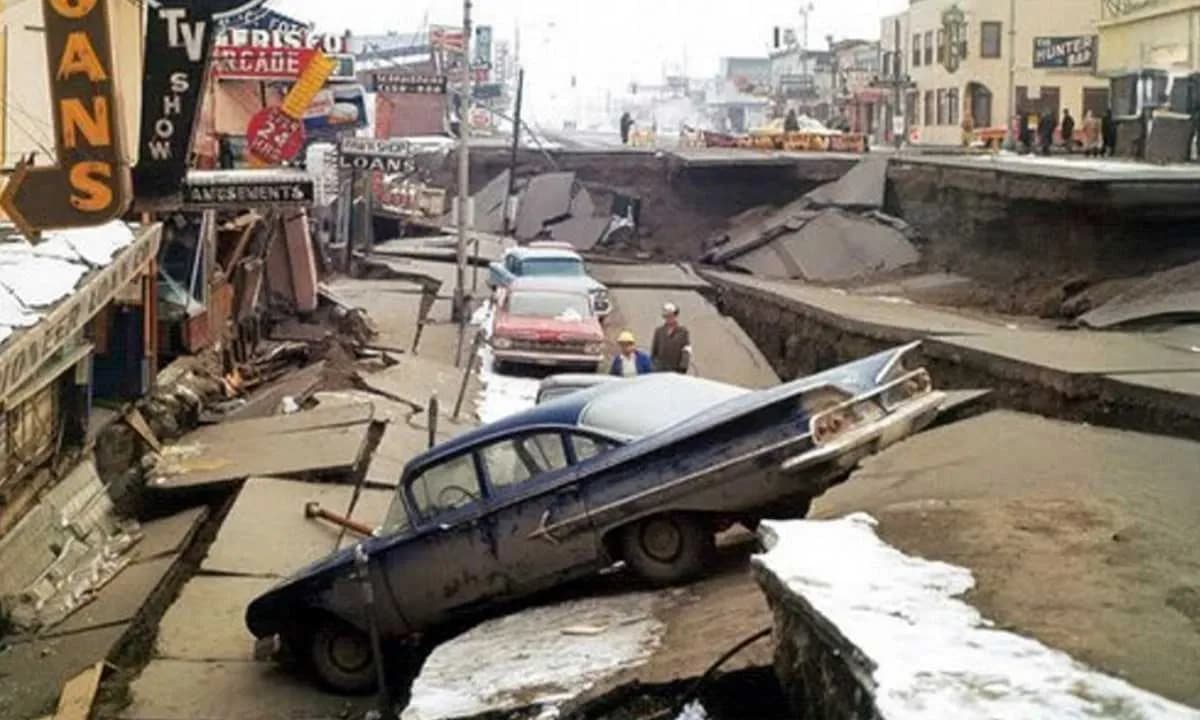
On March 27, 1964, at precisely 5:36 PM, a catastrophe struck south-central Alaska that would forever change the landscape of the region, and in fact, the world. Known as the Great Alaska Earthquake or the Good Friday Earthquake, it was the second-largest earthquake ever recorded, with a magnitude of 9.2. This earthquake was not just a seismic event; it was a monumental force that reshaped entire regions and left a legacy that still resonates today.
The earthquake’s epicenter was located just off the coast of Prince William Sound, northeast of Kodiak Island. It lasted for a staggering four minutes and thirty-eight seconds, shaking the land with an intensity that no one could have prepared for.
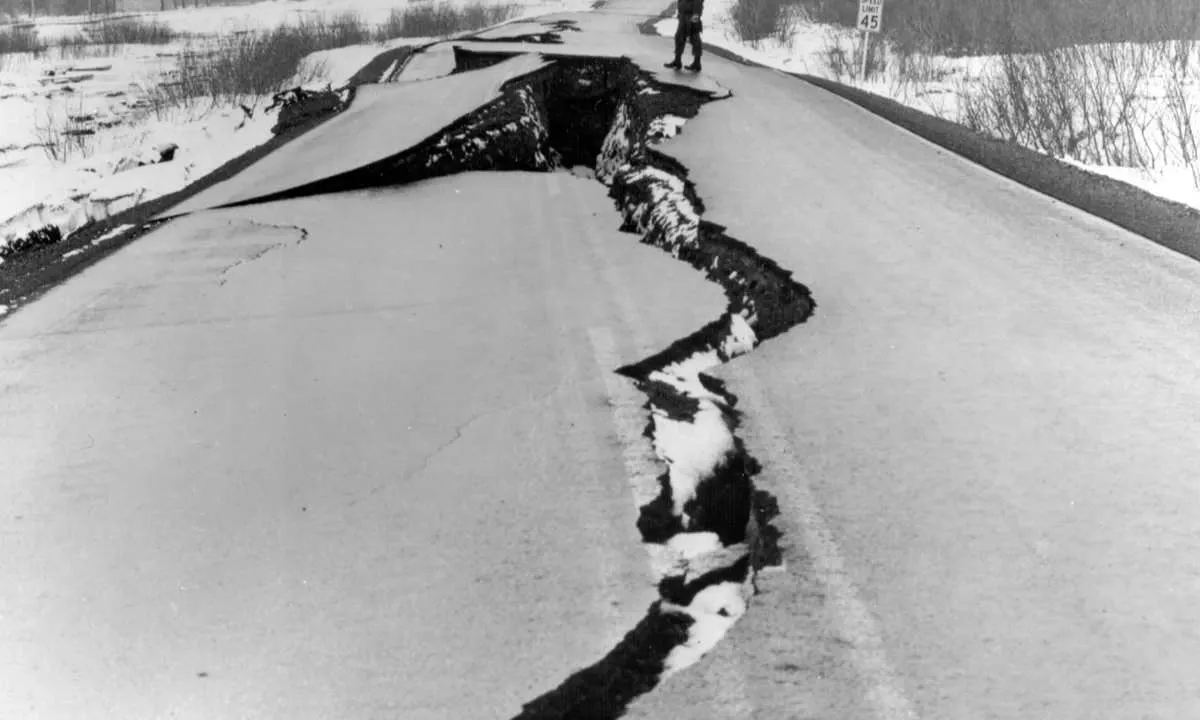
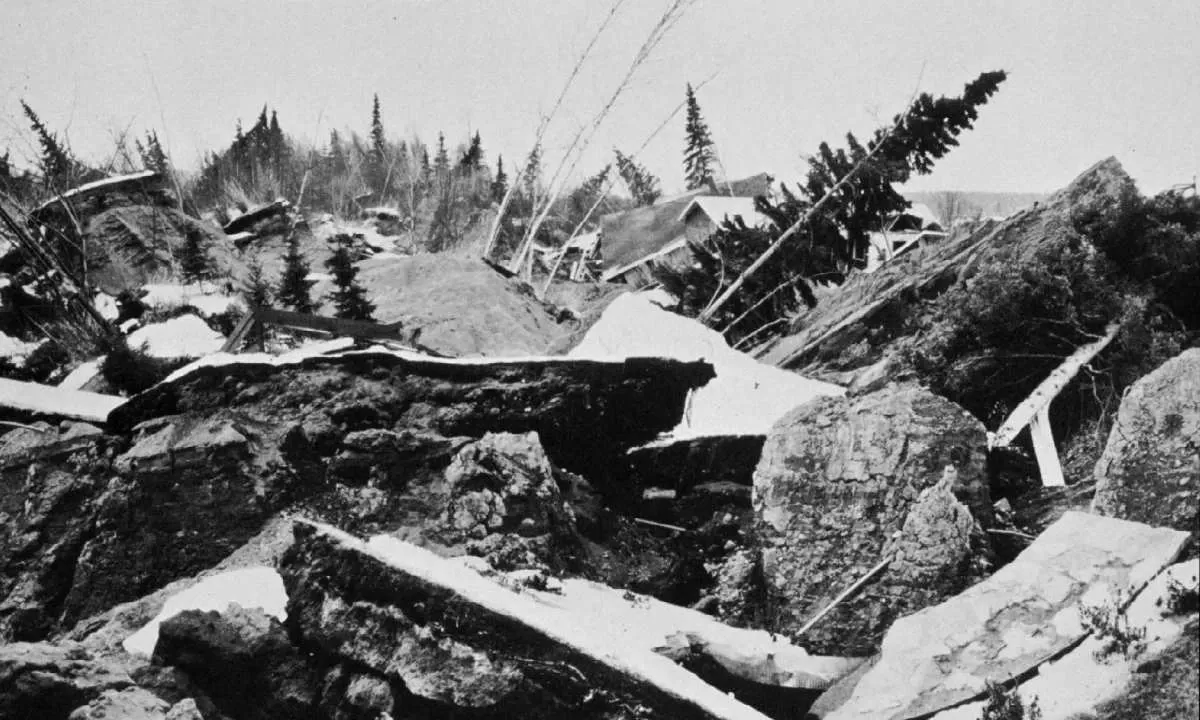
The massive shift in the earth’s plates resulted in violent ground ruptures, landslides, and substantial property damage across Alaska. The power unleashed during those few minutes was equivalent to about 500 years of stress buildup along the fault line between the Pacific and North American plates.
As the ground shifted, the destruction was immediate. Anchorage, Alaska’s largest city, saw widespread damage. The city was not hit by the tsunamis that followed the earthquake, but the ground beneath it fractured and shifted dramatically. The Turnagain neighborhood, built on sandy bluffs over Bootlegger Cove clay, was one of the hardest hit, with 75 homes lost to landslides.
Other parts of the city also suffered damage to buildings, water systems, roads, and electrical infrastructure, especially in the areas along Knik Arm. The city, which had no real earthquake preparedness at the time, was left in shock, its residents scrambling for safety and trying to comprehend the scale of the disaster.
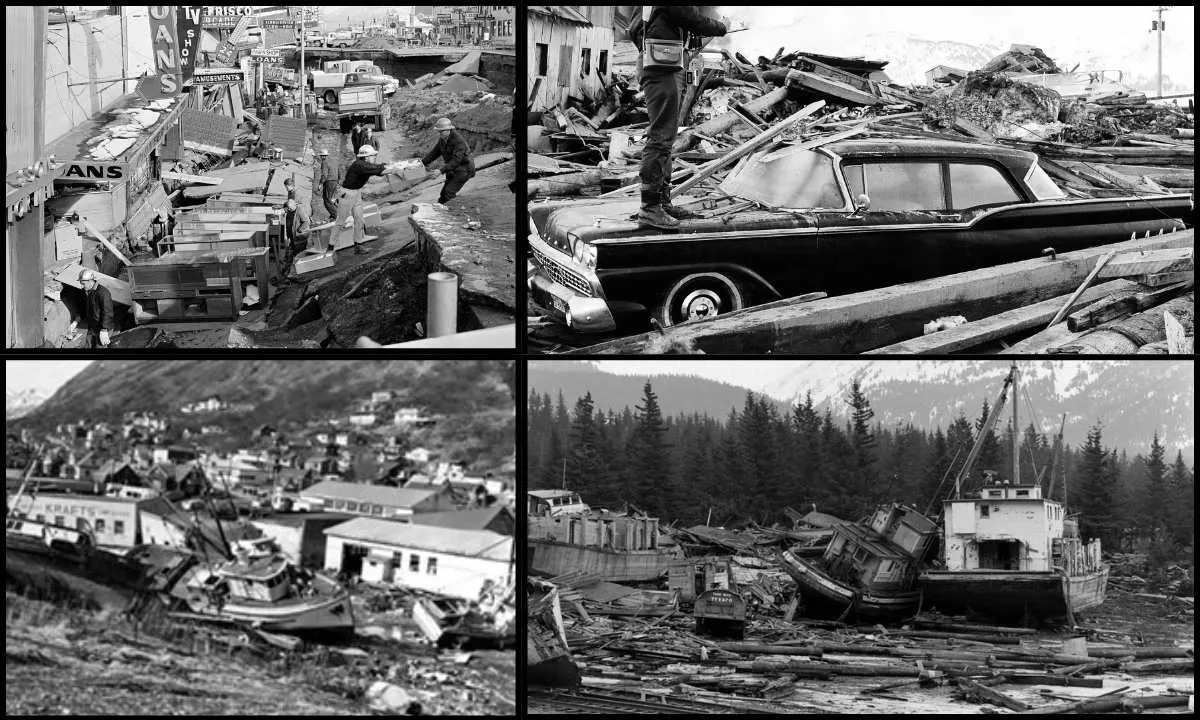
But the devastation didn’t end with the quake. The tsunami, triggered by the seismic activity beneath the ocean, surged across the Pacific Ocean. Within minutes, massive waves up to 220 feet (67 meters) high were created, swallowing entire coastal villages in Alaska. In Prince William Sound, the town of Chenega was nearly wiped off the map by a 27-foot (8.2 m) wave that killed 23 people.
In Port Valdez, 32 more lost their lives when an underwater landslide collapsed the city’s harbor. Elsewhere in Alaska, communities like Whittier, Kodiak, and Seward were left in ruin, as the waves washed over their waterfronts, taking everything in their path.
The damage wasn’t confined to Alaska alone. Tsunami waves reached as far as Hawaii, Japan, and even the U.S. West Coast. In Crescent City, California, 29 city blocks were destroyed, and 11 people were killed by the waves. The waves reached Oregon and Washington, with several deaths occurring along the coast. The tsunami’s impact was felt as far away as British Columbia in Canada, and the aftershocks rippled through the entire Pacific Ocean, spreading the damage across thousands of miles.
The immediate human toll was heavy. In total, 139 lives were lost – 15 due to the earthquake itself and 124 from the resulting tsunamis. But the damage to property was even more staggering. The costs of the destruction have been estimated at $4 billion in today’s dollars.
Entire towns were devastated, and some, like the town of Valdez, had to be relocated to higher ground. The U.S. military, aided by local officials and scientists, quickly mobilized to help with recovery efforts. It wasn’t just about rescuing survivors; it was about rebuilding a state that had never experienced a disaster on this scale.
The earthquake also had a profound effect on the natural environment. The shaking and the subsequent flooding and landslides caused severe damage to local ecosystems. Coastal marshlands, forests, and freshwater habitats, critical for wildlife such as migratory birds and salmon, were destroyed.
The wildlife that depended on these areas, including moose, deer, and other animals, faced massive disruptions. Many of the natural resources that Alaska relied upon for its livelihood were obliterated in the wake of the disaster.
The geological impact was equally dramatic. The ground in some areas of Alaska was raised by as much as 38 feet (12 meters), while other areas subsided by as much as 8 feet (2.4 meters). The changes to the landscape were so extensive that it permanently altered the geography of the region. New shorelines were created, and areas that were once rich in natural resources became barren wastelands.
The ripple effects from the earthquake didn’t stop there. In the aftermath of the event, the scientific community and governments took action to learn from the tragedy. The U.S. military played a vital role in organizing rescue efforts, and President Lyndon B. Johnson quickly declared all of Alaska a major disaster area.
The U.S. Army Corps of Engineers led the reconstruction efforts, helping rebuild roads, clear debris, and establish new towns for displaced residents. The creation of the West Coast and Alaska Tsunami Warning Center was a direct response to the disaster, and the event led to increased global awareness of earthquake preparedness.
The legacy of the 1964 earthquake goes beyond the physical changes to the land. It changed how the world viewed natural disasters, especially tsunamis. The event also reshaped the way countries prepare for and respond to such catastrophes. It highlighted the need for better earthquake engineering, better disaster preparedness, and the importance of having effective warning systems in place to protect human lives and property.
Today, the memory of the 1964 earthquake and tsunami is honored in places like Earthquake Park in Anchorage, where the devastation of the event is marked, and the lessons learned from it are passed on to future generations. While the earthquake itself was an unprecedented disaster, it also served as a catalyst for change, helping to shape the modern understanding of seismic activity and disaster response.
The 1964 Alaska earthquake remains a defining event in history, not just for its immediate destruction, but for the way it changed the world’s approach to understanding and preparing for natural disasters. It serves as a reminder of the immense power of the earth beneath our feet and the unpredictable forces of nature that can forever alter the course of history.