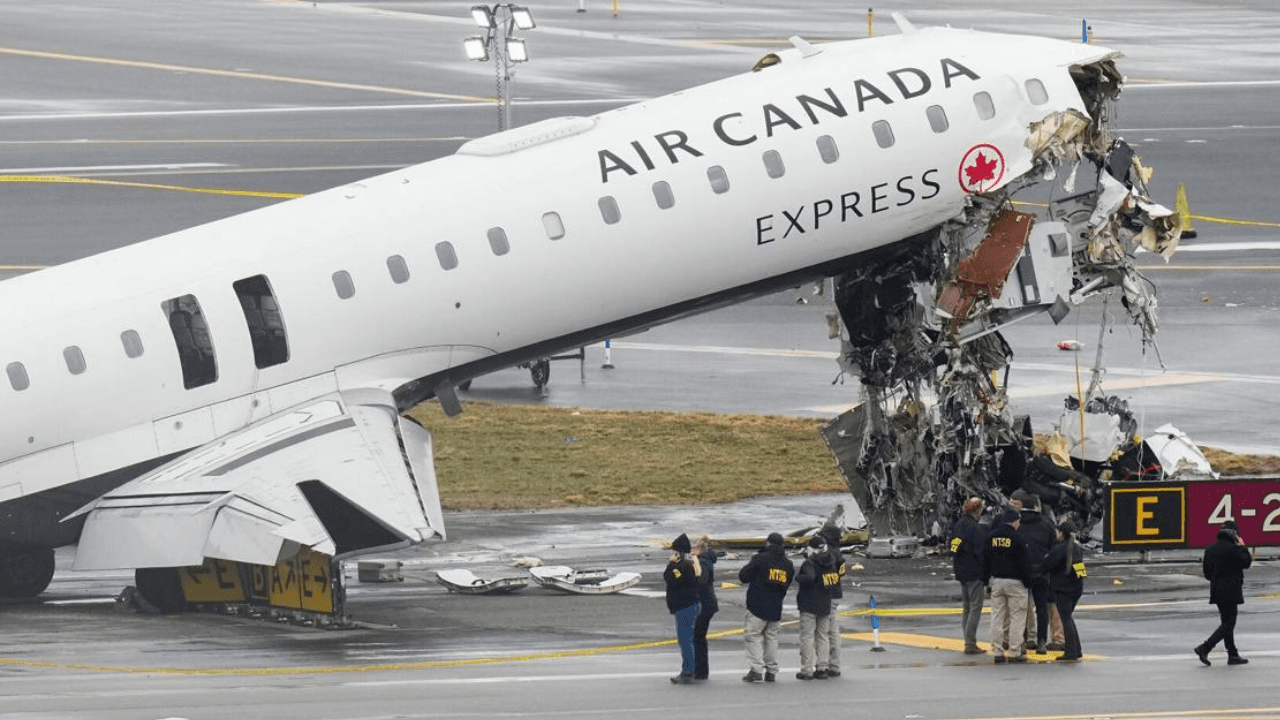
In a crash that killed two pilots, one survivor’s story is being called nothing short of a miracle.
A flight attendant on an Air Canada Express plane survived after being thrown from the aircraft during a collision at New York’s LaGuardia Airport.
Her survival has stunned both her family and aviation experts.
The incident is now under investigation as authorities review what went wrong.

A Shocking Survival Story
The flight attendant, identified as Solange Tremblay, was still strapped into her seat when she was ejected from the plane.
Her daughter described her survival as a “total miracle” in an interview with Canadian media.
Tremblay suffered multiple fractures in one leg and will require surgery, but she is expected to recover.
Her family says they are still trying to process how she survived such a violent impact.
What Happened During the Crash
The Air Canada Express flight was landing at LaGuardia Airport when it collided with a fire truck on the runway.
The aircraft was carrying more than 70 passengers at the time.
The front of the plane was heavily damaged, and both the pilot and co pilot died from their injuries.
Emergency crews responded quickly and evacuated passengers from the scene.
Why She Survived
Aviation experts believe Tremblay’s survival may be linked to her position on the aircraft.
Flight attendants sit in reinforced jump seats that are built to handle extreme forces.
These seats are attached to the aircraft structure and often include four point harness systems.
According to safety experts, they are designed to protect crew members so they can assist passengers after a crash.
Information on aircraft safety design can be found at the Federal Aviation Administration website.
Experts React to the Incident
Former federal crash investigator Jeff Guzzetti called the survival remarkable given the level of damage.
He explained that crew seats are built to withstand higher impact forces than standard passenger seats.
This design can make a critical difference in severe accidents.
More details about aviation accident investigations are available at the National Transportation Safety Board.
A Reminder of Past Incidents
This is not the first time flight attendants have faced extreme conditions during crashes.
In 2013, crew members were injured when an Asiana Airlines plane crashed while landing in San Francisco.
Those incidents have shaped safety improvements in aircraft design and training.
Each case provides new lessons for the aviation industry.
What Happens Next
Investigators are now focused on understanding how the collision occurred.
They will examine runway coordination, weather conditions, and communication between crews.
The findings could lead to new safety measures at major airports.
For now, one survivor’s story stands out as a powerful reminder of both the risks of air travel and the resilience of those onboard.