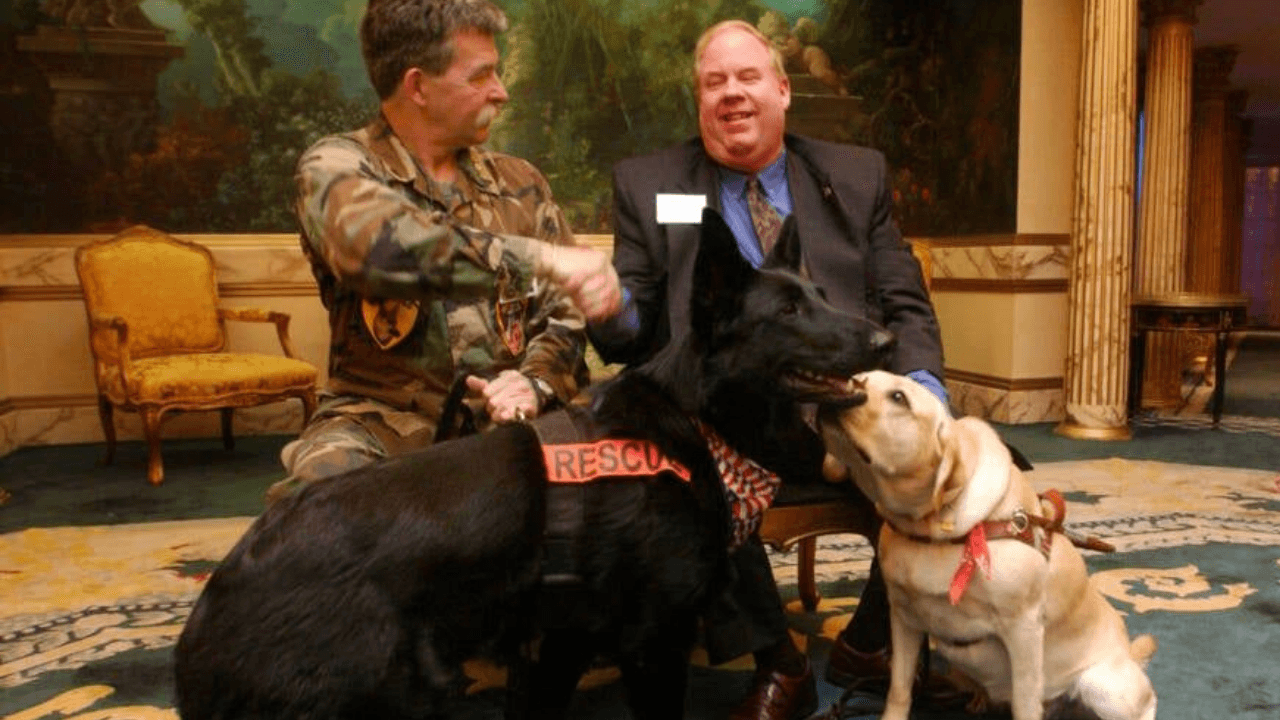
On the morning of September 11, 2001, Michael Hingson was in his office on the 78th floor of the North Tower when everything changed. Hingson, who has been blind since birth, was at work with his guide dog, Roselle, when American Airlines Flight 11 struck the building. The moment threw thousands of people into fear, but Hingson says Roselle stayed calm, and that calm helped guide his next decisions.
That detail is part of why this story still stands out more than two decades later. It is not only a survival story. It is also a story about trust, training, and the bond between a man and the dog who helped lead him out of the World Trade Center.

A calm beginning in the middle of chaos
According to the 9/11 Memorial & Museum, Hingson had strong knowledge of the building’s emergency procedures. After the impact, he called his wife and then helped direct people toward the stairwell instead of the elevators. Roselle, a yellow Labrador Retriever trained as a guide dog, got up from under his desk and began her work.
As they moved into the stairs, Hingson later recalled smelling jet fuel. He and a small group then began the long trip down from the 78th floor. The descent covered more than 1,400 steps, and along the way he, Roselle, and coworkers helped keep others focused and moving.
How Roselle helped more than one person
The 9/11 Memorial says Hingson and those around him tried to encourage people who were losing hope during the descent. At one point, Roselle comforted a distressed woman, a small act that people around them remembered in the middle of a terrifying evacuation. Hingson has said that Roselle’s steady behavior helped others feel that they could keep going.
That is one of the most powerful parts of this story. Roselle was trained to guide one person, but in that stairwell her presence helped calm many more. This is an inference based on Hingson’s account and the museum’s description of how others responded to her.

Out of the tower and into another danger
After reaching the lower levels, Hingson and the group were directed away from one exit and found another route out of the complex. Once outside, they realized the scale of the disaster around them. Soon after, Roselle led Hingson away from the area as the danger around the towers grew even worse.
Hingson has described relying completely on Roselle as they moved through confusion and debris. In one key moment, Roselle stopped at the top of subway stairs, preventing him from stepping into an unsafe area without warning. That kind of trained judgment is one reason guide dogs are so valuable, and in Roselle’s case it likely saved his life more than once that morning.
Why Roselle became a symbol of courage
After 9/11, the story of Michael Hingson and Roselle spread widely across the country. Roselle later received the American Kennel Club Humane Fund Award for Canine Excellence in the service dog category in 2002. The AKC says she lived with the Hingson family for the rest of her life and died in June 2011.
Her recognition mattered because it reminded people that heroism does not always look dramatic. Sometimes it looks like discipline, trust, and doing your job in the worst moment imaginable. That is why Roselle’s name still comes up whenever Americans remember stories of bravery from 9/11. This is an inference based on the museum’s continued educational focus on Hingson and Roselle and the honors Roselle received afterward.
Why this story still matters
The story of Michael Hingson and Roselle has lasted because it offers something rare in the history of 9/11. It shows survival without losing sight of humanity. It also shows how preparation, teamwork, and trust can matter even when events feel completely out of control.
Readers who want to learn more can start with the National September 11 Memorial & Museum’s Michael Hingson feature and the American Kennel Club’s account of Roselle’s service. More than twenty years later, their story remains one of the clearest reminders that courage can move on four legs too.