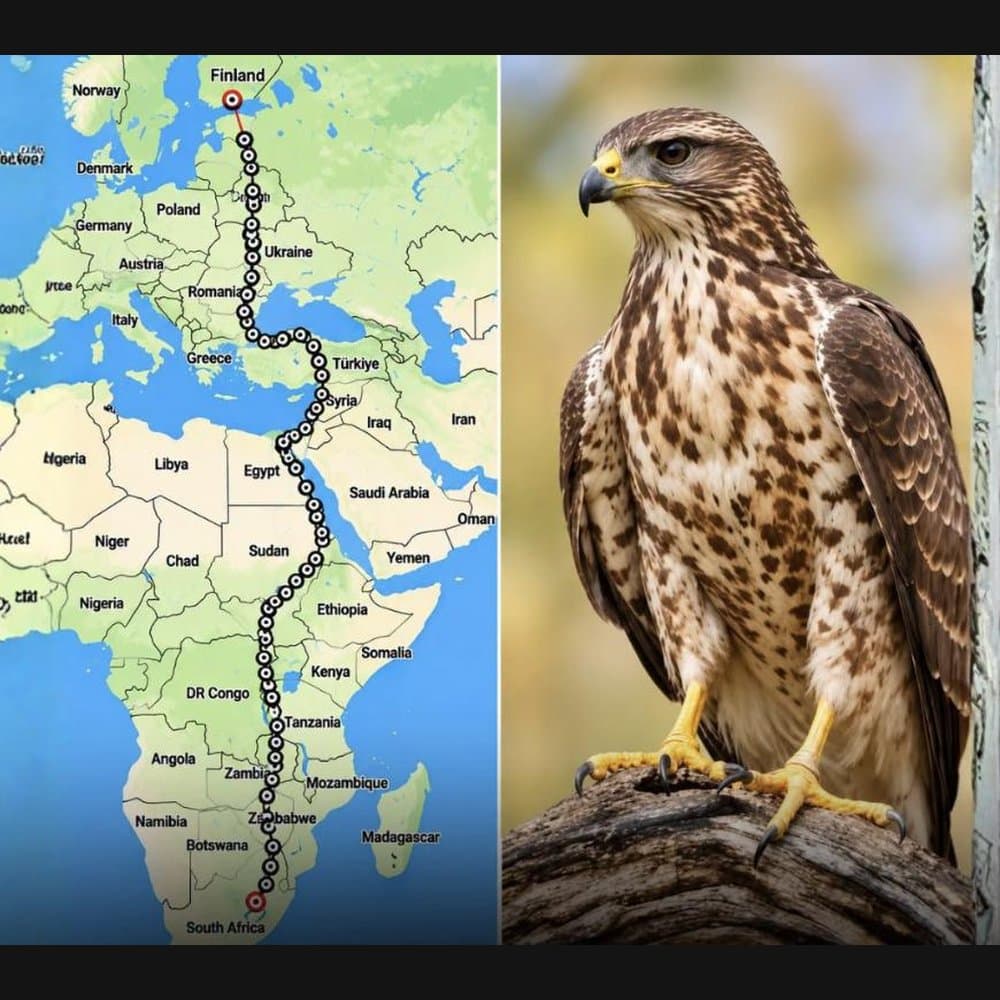
A migration map shared as evidence of a female falcon flying from South Africa to Finland is better understood as a honey-buzzard story. The extraordinary journey is an old tracking account, not evidence of a newly discovered route.
A fact-check tracing the viral claim identifies the journey as a female honey buzzard’s 2015 spring migration. It places the departure near Reitz in South Africa on April 20 and arrival in Finland on June 2, describing a trip of roughly 10,000 kilometers over 42 days.
Those figures should stay attributed to the traced account. The exact individual bird and original map file have not been independently matched here.
The real research behind the maps
Satellite tracking of honey buzzards between Finland and Africa is well documented. Novia University of Applied Sciences describes Project Honey Buzzard, initiated in 2011 by researcher Patrik Byholm, as a collaboration that followed birds throughout their lives.
Transmitters allowed researchers to study migration and habitat use. The project brought together collaborators in Finland, the Netherlands, Germany and South Africa. Its observations also helped investigate dangers encountered along migration routes.
The scientific value goes beyond drawing a long line on a map. Tracking can reveal where birds pause, how routes differ and where they encounter human-caused threats. Novia describes applications involving wind-turbine collision risk and shooting.
A route is not a nonstop flight
A line joining locations over several weeks should not be read as an uninterrupted flight. It represents a journey across time. Dividing a distance by the number of days does not reveal a bird’s cruising speed or prove it stayed airborne throughout.
Researchers have also examined how wind and geography shape migration. A 2017 peer-reviewed study followed juvenile honey buzzards on their first outward migrations. That is related scientific context, not a study of the particular adult return journey in the viral caption.
Accurate labels make the story stronger
The important corrections are simple: identify the species carefully, retain the historical date and avoid suggesting that every accompanying bird portrait shows the tracked individual. The supplied composite has not been verified as the original scientific map or a photograph of that bird.
The underlying research needs little embellishment. Small transmitters have helped scientists follow birds across continents—and turn those movements into evidence useful for conservation.