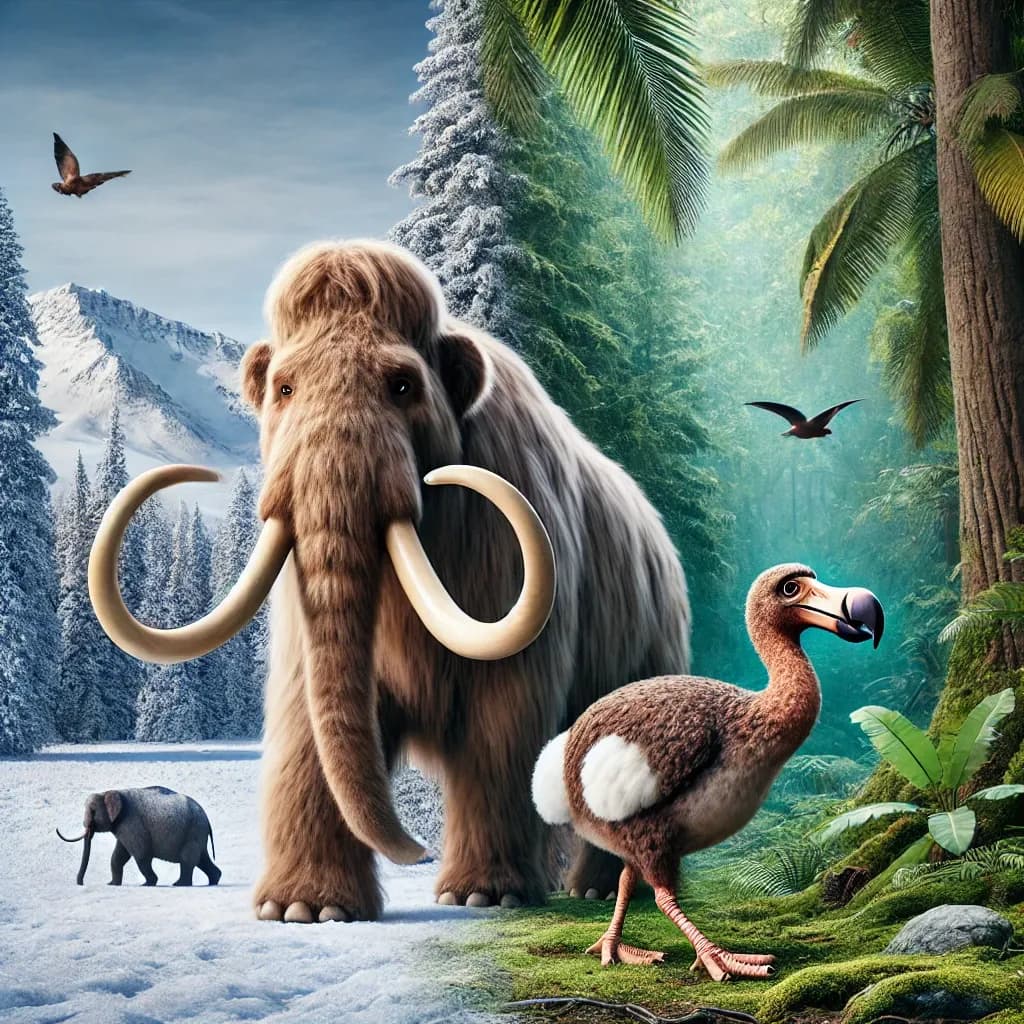
Picture it: a Woolly Mammoth, thousands of years after vanishing from the Earth, roaming the Arctic tundra. Or a Dodo, last seen in the 1600s, pecking around Mauritius as if it never left. It sounds like pure science fiction—yet, thanks to recent breakthroughs, these scenes might soon be reality.
At the center of this wild endeavor is Colossal Biosciences, a Texas-based biotech company. Founded by entrepreneur Ben Lamm and renowned geneticist George Church, Colossal has launched an audacious project to bring back long-lost species. Their first goal? Revive the Woolly Mammoth by 2028. Using CRISPR, a cutting-edge gene-editing tool, scientists are blending Mammoth DNA with that of the Asian elephant, the Mammoth’s closest living relative. The idea is to create a Mammoth hybrid capable of surviving in Arctic climates, where it could even help slow down climate change by preventing permafrost from thawing.

And Mammoths are just the beginning. Colossal also has its sights set on reviving the Dodo, the famous flightless bird, and the Tasmanian tiger, which went extinct in the 1930s. Each of these species was once a vital part of its ecosystem, and scientists believe their return could help restore environmental balance. Bringing back the Dodo, for example, might rejuvenate Mauritius’s natural plant life, while the reintroduction of the Tasmanian tiger could rebalance wildlife in Australia’s forests.

Image Source: Wikipedia
It’s both thrilling and unsettling. On one hand, reviving extinct animals is a remarkable feat of science and technology—a way to heal ecosystems impacted by human activity. On the other hand, the idea of releasing “new” ancient species into today’s world is complex. Experts are asking questions: Could these reintroduced animals disrupt current ecosystems? Will they survive, or could their presence cause unexpected problems? It’s as much a leap into the unknown as it is a leap forward in conservation science.
And it’s a project that has attracted some high-profile support. Chris Hemsworth and Paris Hilton, for instance, are backing Colossal Biosciences, bringing even more attention to the possibilities—and risks—of de-extinction. Their support has sparked global curiosity and brought new energy to the field, with people around the world eagerly following these developments.
As we approach 2028, a world with Mammoths, Dodos, and Tasmanian tigers no longer feels purely imaginary. It’s a bold, brave move that sits at the intersection of environmental science, technology, and our deep fascination with nature’s past. The possibilities are astonishing, though they remind us of how much there is to consider when crossing the boundaries of life and extinction.