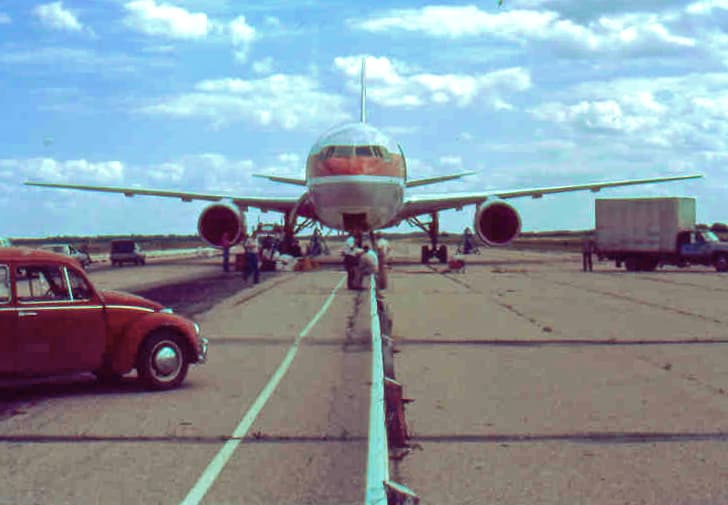
On July 23, 1983, three boys were riding their bicycles down a drag strip in Gimli, Manitoba, when a Boeing 767 came into view. Art Zuke, 14, and his friends had been riding along a former military runway. The jet was coming down toward the strip, and both engines had stopped. All three boys got out of its path. Winnipeg Free Press interviews with the witnesses.
On board Air Canada Flight 143 were 61 passengers and eight crew. Captain Robert “Bob” Pearson and First Officer Maurice Quintal had set out for Edmonton on a flight from Montreal that stopped in Ottawa. They ended up landing at a former air base Quintal knew from his military service. Everyone aboard survived. Canadian Board of Inquiry report.
Why Flight 143 ran out of fuel
The cockpit fuel gauges were blank, so the fuel in the tanks was measured manually. Air Canada’s new 767 used kilograms for fuel, while staff were accustomed to working in pounds. The people calculating the fuel load used a conversion factor that gave them a weight in pounds, then treated the result as kilograms. The aircraft departed with less than half the fuel it was supposed to carry. Canadian Board of Inquiry report, Part III.
The first low-pressure warning came while the jet was cruising at 41,000 feet over Ontario. Pearson began descending toward Winnipeg. Another warning followed on the right side, and then the engines quit one after the other. With Winnipeg beyond gliding range, Quintal suggested Gimli. He knew the airfield from his time in the Royal Canadian Air Force. Canadian Board of Inquiry report, Part II.
The landing at Gimli
On approach, Pearson still had too much altitude to lose before touchdown. An experienced glider pilot, he put the 767 into a sideslip. The maneuver let him lose height quickly without building up forward speed. Below him was a runway partly converted for drag racing, with drivers and their families gathered near the far end. Winnipeg Free Press reconstruction.
The main landing gear locked into place, but the nose gear did not. It collapsed after touchdown, and the front of the aircraft scraped along the concrete. Investigators found that the friction helped slow the jet, which stopped before reaching the people at the far end. Some passengers suffered minor injuries during the evacuation. No one on the ground was hurt. Canadian Board of Inquiry report. Radio Canada International’s account of the evacuation.
What the inquiry found
The board found that a working fuel processor would have prevented the accident. It also identified failures in how the airline introduced metric aircraft, assigned responsibility for fuel calculations, trained staff and cleared the aircraft to fly with blank gauges. Canadian Board of Inquiry report, Part III.
The aircraft was repaired and returned to service. It flew until 2008, the year of the landing’s 25th anniversary. Quintal died in 2015 at 68. Canada’s Aviation Hall of Fame has named Pearson and Quintal as recipients of its 2027 Canada’s Aviation Distinction Award for the skill and teamwork that saved everyone aboard. Aircraft retirement and Quintal’s death. Canada’s Aviation Hall of Fame announcement.
Featured photo taken after the 1983 landing. Copyright holder release via Wikimedia Commons. Reproduced as supplied. Original photograph. CC BY-SA 3.0 license.
