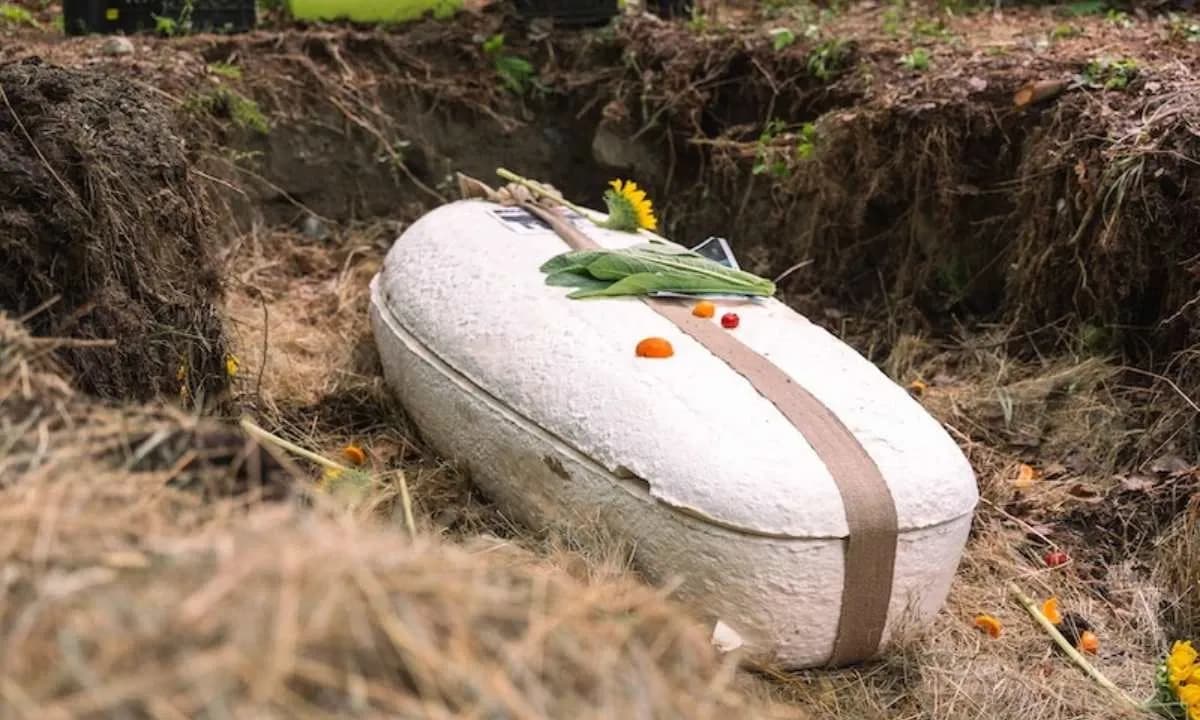
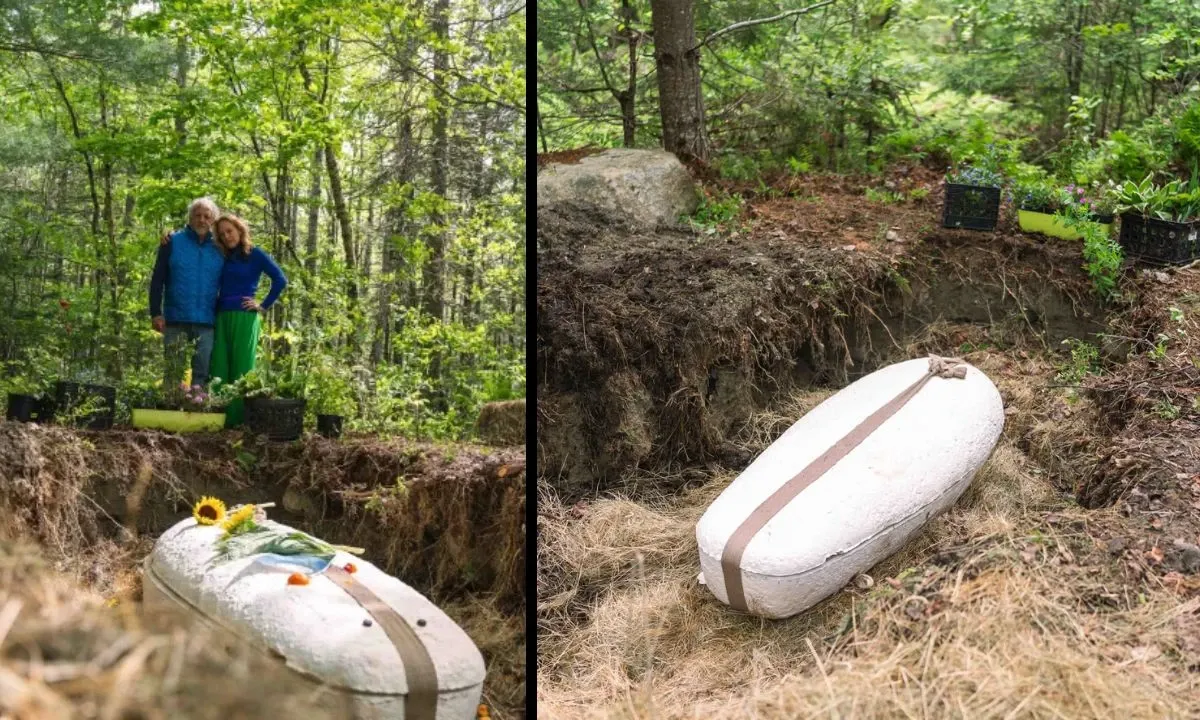
On a quiet hillside in rural Maine, something quietly revolutionary took place. A man named Mark C. Ancker was laid to rest, not in a traditional wooden coffin, but inside something entirely new to North America — a coffin made from mushrooms.
Mark’s daughter, Marsya Ancker, said this unique burial was exactly what her father would have wanted.
“He always told me that he wanted to be buried in the woods on the property that he loved so much. He wanted his final resting place to nourish the land and plants he cherished.”
Mark’s daughter, Marsya Ancker shared.
And that’s what happened. Instead of a gravestone, the family planted a flower garden over his resting place — turning grief into growth, and death into renewal.
This burial marked the U.S. debut of a mushroom-based casket called the Living Cocoon, created by the Dutch company Loop Biotech. The casket is made entirely from mycelium, which is the root structure of fungi. It looks like a fibrous, white, sponge-like material — but what it does is even more remarkable. It can be grown in just seven days, and once buried, it fully biodegrades within 45 days, enriching the soil as it breaks down.
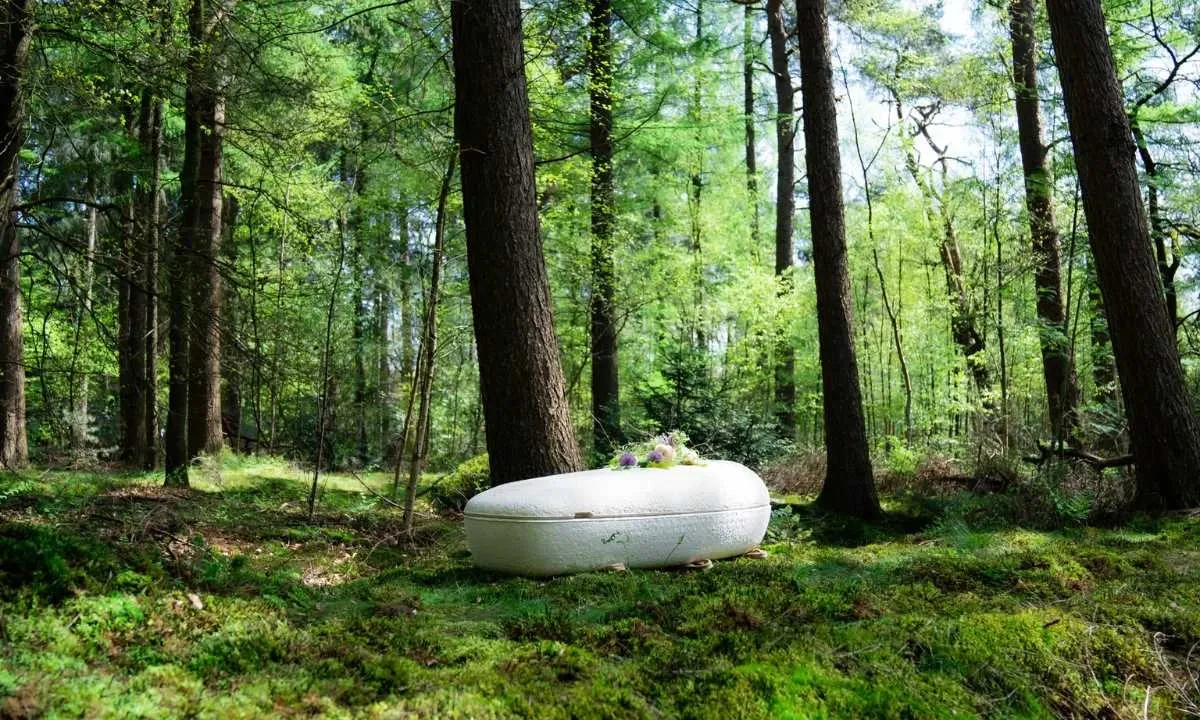
Loop Biotech isn’t new to this. Since 2021, the company has facilitated over 2,500 mushroom coffin burials in Europe. But this moment in Maine was their first in North America. And while the Ancker family held a small, private service, their decision might spark a much larger shift in how we think about death — and the planet.
The traditional burial industry has long had a serious environmental impact. According to the Green Burial Council, every year in the United States, burials use around 20 million board feet of hardwood, 4.3 million gallons of embalming fluid, and 1.6 million tons of concrete reinforced with steel. These materials take centuries to break down — and embalming fluids, often made of formaldehyde and other chemicals, can contaminate soil and water.
That’s why green burial practices have been growing in popularity, especially since the 1990s. These practices avoid harmful chemicals, hardwoods, and synthetic linings. Instead, they use biodegradable materials that let the body decompose naturally and return to the earth. The Green Burial Council, founded in 2005, has now certified over 250 green providers and recorded more than 400 green cemeteries across the U.S. and Canada — showing a rising interest in environmentally conscious end-of-life choices.
The Living Cocoon isn’t just a product — it’s part of a bigger idea. Bob Hendrikx, the founder of Loop Biotech, actually came up with it while studying architecture in the Netherlands. He had been experimenting with using mycelium to make self-healing buildings. But when someone jokingly asked what would happen if their grandmother died inside one of these homes, it sparked a new idea in Bob’s mind. “Oh my God, this should be a casket,” he remembered thinking. What began as a student project turned into a company and a movement.
Bob now believes that funerals shouldn’t just mark an ending — they should also offer a beginning.
“We created the Loop Living Cocoon to offer a way for humans to enrich nature after death. It’s about leaving the world better than we found it.”
Bob said.
This vision is shared by others leading the green burial movement. Ed Bixby, founder of the Global Green Burial Alliance, believes our final act can be a gift to the Earth.
“Death is the only guarantee in life. It is how we choose to embrace death that paints the landscape for generations to come. To embrace the living with our death becomes the final act of kindness we can bestow upon our planet.”
Ed Bixby, founder of the Global Green Burial Alliance
The Alliance, founded in 2022, is a volunteer-run network that educates people about green burial options and connects families to providers. They believe families should have a say in how they say goodbye — and that those goodbyes can be more meaningful when they also help the planet.
The use of mycelium is part of a larger trend where fungi are being used in surprising and helpful ways — from making biodegradable packaging to building materials and even clothing. Mycelium is cheap to grow, quick to produce, and completely natural. It doesn’t just disappear — it gives back to the soil by feeding new plant life.
The story of Mark Ancker’s burial is emotional, but also forward-thinking. It’s not about rejecting tradition — it’s about rethinking what it means to leave something behind. For his family, it was about honoring a man’s love for nature. For others, it might open the door to a different kind of legacy — one that starts not with a tombstone, but with new life blooming from the ground.
In a world where even death has an environmental footprint, this mushroom coffin offers a gentler, cleaner goodbye. And for those who find comfort in nature, it might just be the most peaceful way to go.