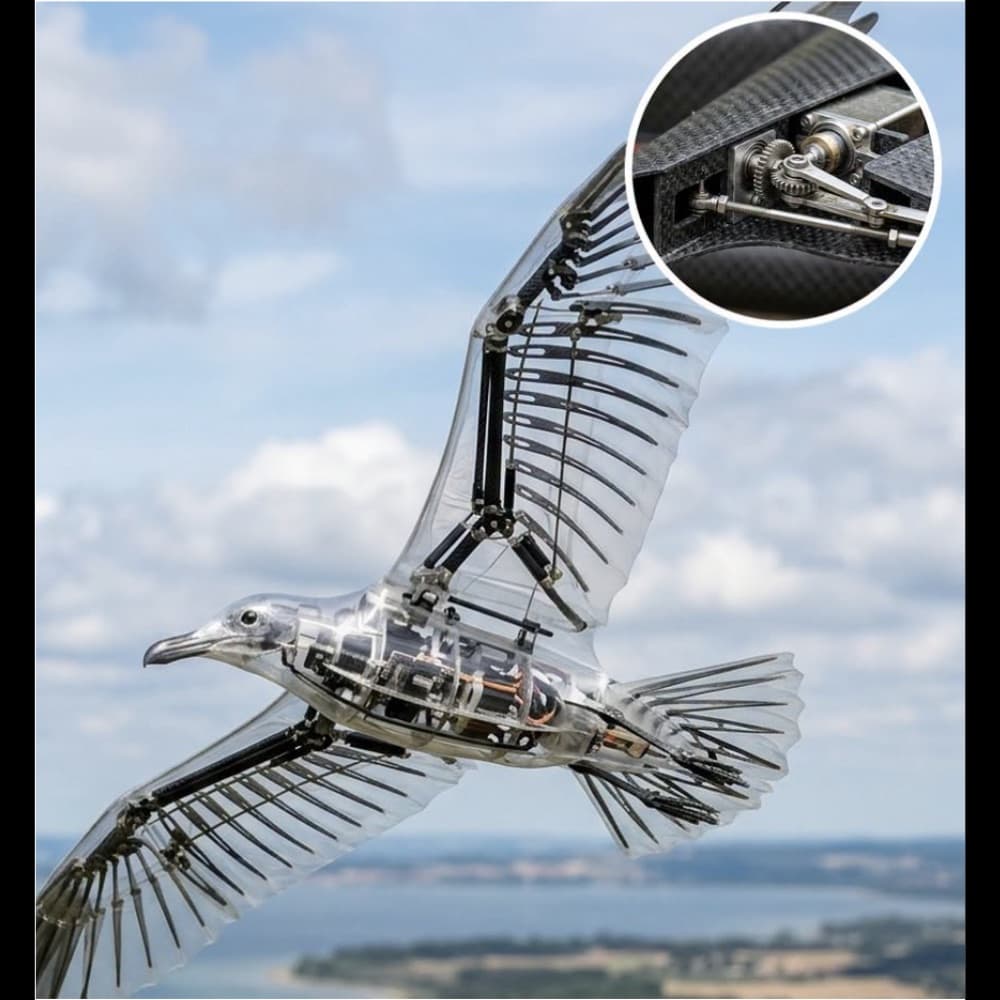
A flying machine with a two-meter wingspan and a mass of just 450 grams demonstrated how flapping wings can generate both lift and propulsion.
Festo introduced SmartBird in 2011 as part of its Bionic Learning Network. The project took inspiration from a herring gull.
More than an up-and-down motion
Festo’s technical documentation describes a carbon-fiber structure with a lightweight polyurethane-foam covering. Its electrical power requirement was listed as 23 watts.
The wings do more than flap. Active torsion changes their angle during movement, helping the machine make effective use of each stroke.
The design also uses head and tail movements for control. It is an engineering demonstration of coordinated motion, lightweight materials and aerodynamic design.
What the achievement means
SmartBird should not be presented as the first time anyone achieved flapping-wing flight. Ornithopters have a longer history, and Festo’s project represents a particular approach within that field.
Likewise, an efficiency figure should not be translated casually into a claim that a fixed percentage of all wing motion becomes forward thrust. Different efficiency measures describe different parts of a system.
The documented specifications are impressive without those additions: a very light, gull-inspired robot capable of powered flight using moving wings instead of a conventional propeller.