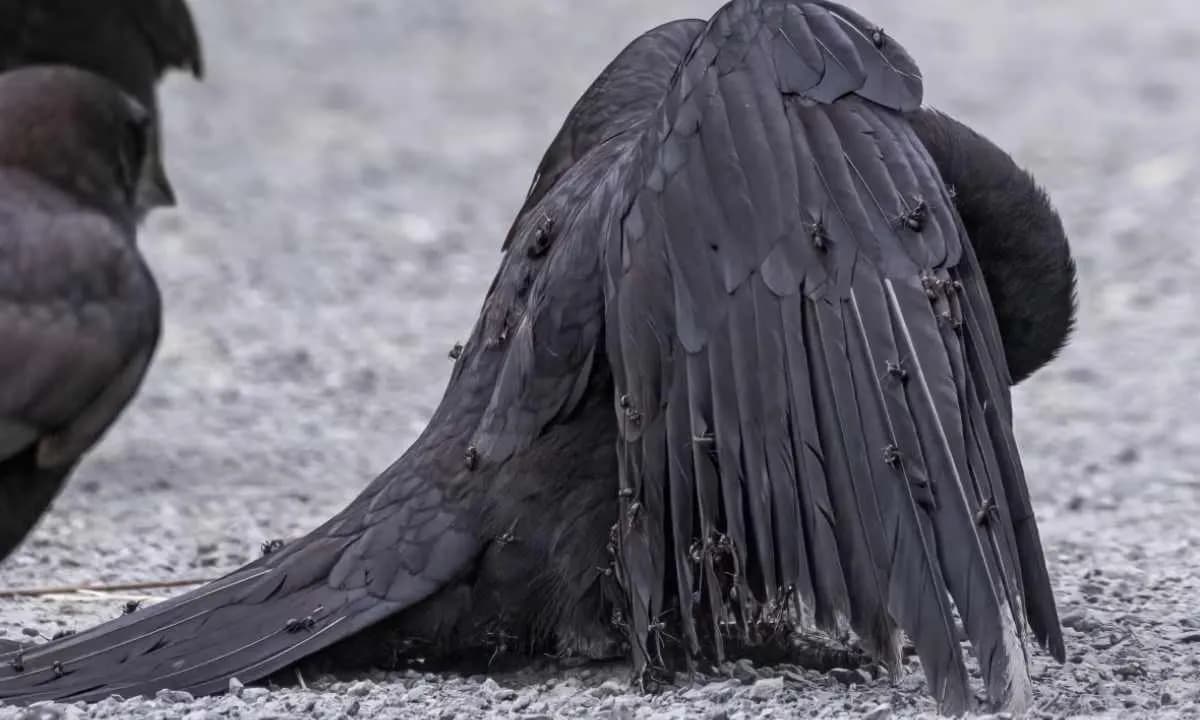
While walking through the Swan Lake Christmas Hill Nature Sanctuary in British Columbia, photographer Tony Austin thought his day of birdwatching had been a bust. He was heading back to his car after three hours with no luck — until a group of crows landed nearby.
That moment turned into something far stranger than he expected.
One of the crows began flapping around on the ground, hopping into the bushes and returning, repeating this odd motion several times. Tony thought it might be hurt or had landed in an anthill by accident. But when he looked closer through his long lens camera, he saw something truly unexpected: the crow was covered in ants. And it seemed like it was doing this on purpose.
A Crow Taking an “Ant Bath”?
After Tony posted the photos online, other bird watchers and scientists chimed in. The crow wasn’t hurt — it was engaging in a known but still puzzling behavior called anting.
This is when birds rub ants all over their bodies. Some do it by holding ants in their beaks and smearing them onto their feathers. Others lie directly on the ground, letting ants crawl onto them. Scientists call these two styles active anting and passive anting.
Tony’s crow seemed to be doing a mix of both — flapping on the ground, disappearing into the foliage, then hopping back out. Oddly, none of the other crows were concerned. They just watched, curious but calm. And only one bird participated.
“They were all strutting around… they didn’t seem alarmed. For a smart bird, if another bird is in distress, I think they do tend to show that they’re quite upset. But these guys didn’t seem to be bothered at all.”
As Tony recalled.
Why Do Birds Do This?
That’s the mystery — and scientists aren’t entirely sure.
There are several theories:
Insect Defense Chemicals
Some ants spray formic acid and other chemicals to protect themselves from predators. Birds might be using this spray for their own benefit — to kill or repel parasites like mites and lice on their feathers. In one study from 1943 in Transbaikalia, Russia, birds that had been anting had a significantly higher number of dead mites than those that hadn’t. Their feathers even smelled strongly of formic acid hours later.
Fungus and Bacteria Protection
The formic acid from ants can also slow the growth of fungi and bacteria that destroy feathers. Experiments have shown formic acid works well in lab settings, but the results aren’t clear when only natural doses (like those from real ants) are used.
Food Preparation
Some birds may be making ants more edible. Ants produce acid to protect themselves, and rubbing them around first might remove or reduce that acid, making them easier — and safer — to eat.
Feather Grooming
Another theory is that anting helps birds preen better. The rubbing could bring saliva into the feathers or help clean old oil and debris off.
Self-Stimulation
Some scientists suggest birds might do it just because it feels good, like how humans engage in habits like smoking or using scented oils. But this is still just a theory, with no solid proof.
Feather Growth During Molting
Birds often ant more during molting season — especially on wings and tail feathers, where new feathers are growing. Anting could help with this process somehow, but not all birds do it during molt.
Not Just Crows
More than 200 bird species around the world have been seen anting, including starlings, blackbirds, robins, and ravens. Some birds even use substitutes when ants aren’t available — like grasshoppers, snails, millipedes, caterpillars, mealworms, and wasps.
European starlings have even been observed grabbing balls of ants in their beaks to use later. Some ants are used more than once — but rarely more than three times.
The most popular ants for anting come from the Formicinae subfamily, known for their ability to spray formic acid. Birds clearly show a preference for these over other ant types like Dolichoderinae or Myrmicinae.
Observing the Behavior
In another case, a blogger spotted two carrion crows anting near a tree in a residential area. One crow began pecking around the base of the tree and rubbing its body into the ground. Soon, the second crow joined in. The birds spread their wings, pressed into the soil, and disturbed the ant nest — possibly encouraging the ants to crawl over them. These motions — opening wings, dragging tails, lying close to the ground — are all typical signs of passive anting.
The observer compared it to disturbing an anthill at a picnic — only this time, the birds were clearly doing it on purpose.
A Behavior We Still Don’t Fully Understand
Even though the behavior was first written about in 1831 by American ornithologist John James Audubon, and again in various papers through the 1800s and early 1900s, scientists still debate what exactly is happening and why.
Some studies show anting kills mites. Others say the results aren’t strong enough to prove that’s its main purpose. Some believe it’s about comfort or grooming. Others think it’s more about preparing food. And some believe it’s something in between.
“It seems that no one is really clear on why they do that, which is kind of mystifying, but exciting as well.” As Tony Austin said after witnessing the behavior.
Final Thought for the Curious Mind
Crows seen covering themselves with ants are still baffling scientists. They are among the smartest birds in the world. They use tools, remember human faces, and even hold what look like funerals. And yet here they are, engaging in a behavior we still don’t fully understand — one that involves carefully placing ants all over themselves.
It’s not supernatural. But it is unexplained. And sometimes, that’s the most interesting kind of mystery.
Also read;