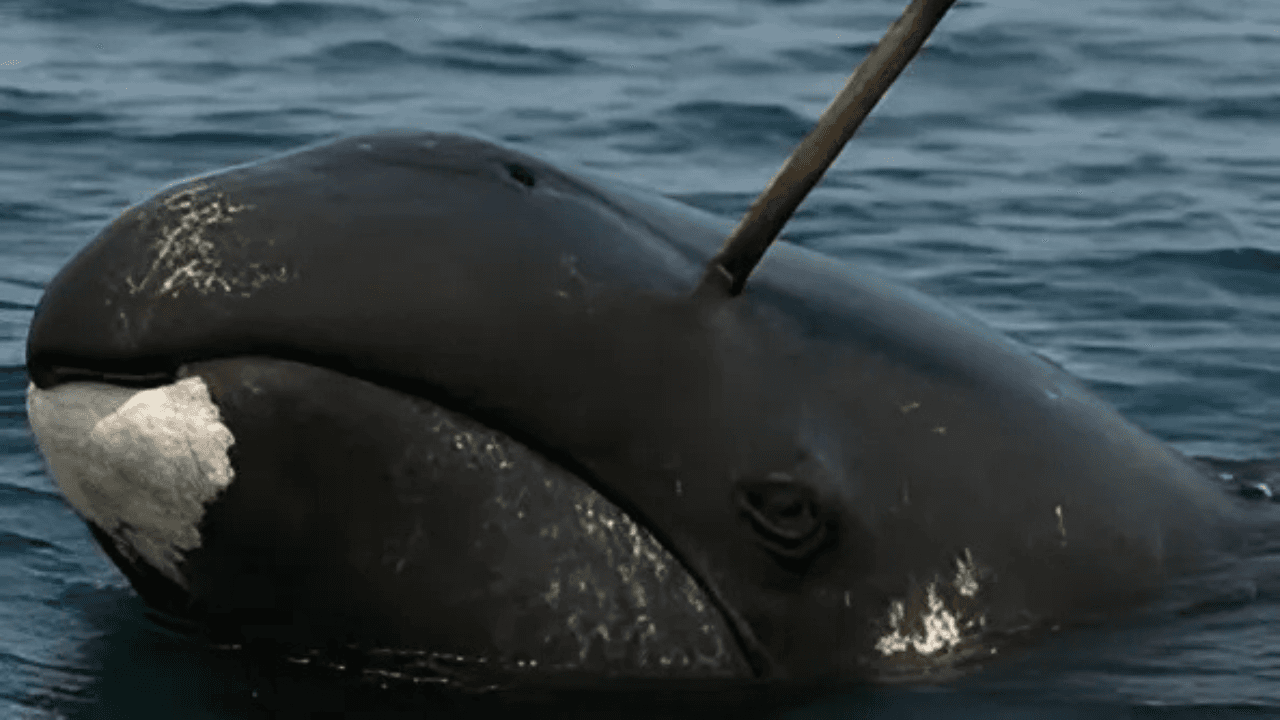
In May 2007, Inupiat hunters off the Alaskan Arctic coast harvested a bowhead whale—and discovered something extraordinary: embedded deep in its flesh was a fragment of a bomb lance, a type of explosive harpoon used by 19th-century whalers. That metal piece turned out to be a key to unlocking the whale’s age: it had carried that weapon for well over a century. The eventual estimate—115 to 130 years old at death—helped shift scientific consensus on whale lifespans.
The Harpoon Fragment Discovery
During the processing of the whale’s carcass, wildlife biologist Craig George (working with North Slope Borough, Alaska) noticed a metallic fragment beneath the blubber in the neck/shoulder region. He sent the fragment to John Bockstoce, a historian at the New Bedford Whaling Museum, for analysis.
The fragment was identified as part of a bomb lance—a weapon with an explosive tip, used in Arctic whaling so the device would detonate after embedding itself in a whale. Its length was about 3½ to 4 inches (≈ 8.9–10 cm).
Dating the Weapon and Deducing Whale Age
Bockstoce traced the weapon to a patented design first appearing in 1879, widely used up to ~1885. Because the fragment was well healed into surrounding bone and tissue, scientists infer it was embedded long before the final harvest.
This gives a rough minimum age anchor: the whale must have lived long enough for the wound to heal and for decades more to pass. Many media reports cite an age estimate of 115–130 years based partly on this weapon dating.
However, this weapon-based age is supplementary, not definitive.
Complementary Age Estimation
To more precisely estimate whale age, scientists use amino acid racemization (AAR) in the eye lens nucleus. Over time, L-aspartic acid converts gradually to its D form at a known rate, serving as a molecular “clock.”
In published studies on bowhead whales, several individuals have been estimated at well over 100 years—and in some cases 150–200+ years—via these chemical techniques. One often-cited specimen’s age estimate reaches ~211 years using this method.
Thus, the harpoon fragment case acts as a compelling real-world data point tied to physical evidence, strengthening confidence in very long lifespans in bowhead whales.
What This Tells Us About Whale Resilience & Longevity
- The fact that the whale survived a bomb lance strike (possibly an explosion) and lived for decades afterward hints at exceptional wound healing and resilience mechanisms.
- The harpoon was deep in the neck/shoulder region, possibly avoided vital organs or blood vessels, so the injury was nonfatal.
- This case helped shift the scientific and public perception of bowhead whales from “long-lived” to “among the longest-living mammals on Earth.”
- It underscores the importance of combining physical artefact evidence with biochemical aging techniques to cross-validate inferences.
Disclosure: We may earn a commission when you make a purchase through the ads.