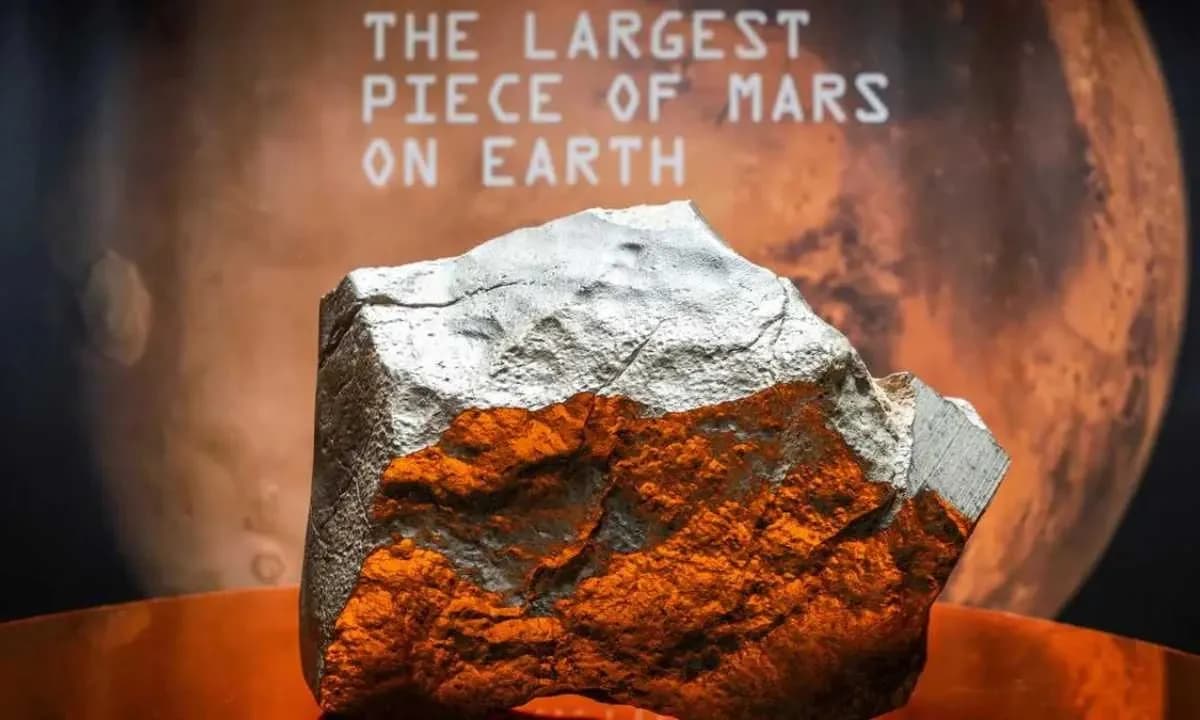
A rock weighing 54 pounds might not sound like much. But when it’s the biggest piece of Mars ever found on Earth, it turns into something extraordinary — and expensive.
That’s exactly what’s happening at Sotheby’s in New York. They’re putting this massive Martian meteorite up for auction, and it could sell for anywhere between $2 million and $4 million.
The rock is officially known as NWA 16788, and it’s not just big — it’s rare. According to Sotheby’s, this is the largest Martian meteorite known on Earth, and it’s about the size of a microwave. Scientists believe it was blasted off the surface of Mars millions of years ago when a huge asteroid slammed into the planet. That impact sent pieces of Martian crust flying into space. One of those pieces eventually made a 140-million-mile journey, flying through the solar system until it landed in the Sahara Desert.
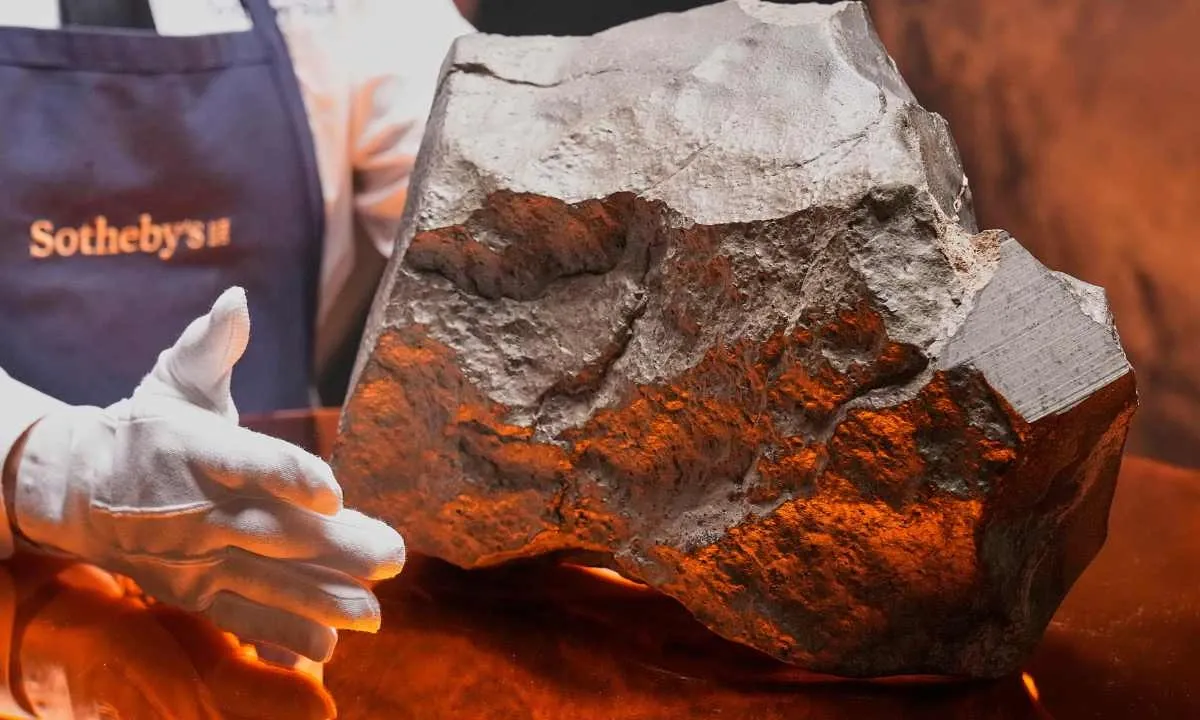
Meteorite hunters later discovered it in Northwest Africa, which is where it gets the “NWA” in its name. These letters are used for any meteorite found in that region. Since then, the rock has been studied and confirmed as being from Mars, using details like its mineral makeup, trapped gas bubbles, and the exact match of its isotopes to other Martian samples.
To put it into perspective, out of the tens of thousands of meteorites that have been found on Earth, fewer than 400 are confirmed to be from Mars. Most of them are small fragments. NWA 16788 is a rare find not only because of where it’s from, but because of how large and intact it is.
This meteorite will be a key part of Sotheby’s Natural History auction, which also features a juvenile Ceratosaurus skeleton. That dinosaur fossil is more than 6 feet tall and nearly 11 feet long, and is expected to attract fossil collectors and museums.
The auction isn’t just about high prices and rare items. It’s also a way to reflect on Earth’s deep history — and our connection to the universe beyond. Holding something that came from another planet, especially Mars, is a reminder that we are part of a much bigger system. As Cassie Brickman, head of Sotheby’s Science and Popular Culture department, explained, these objects “remind us how connected we are to the cosmos.”
The Martian rock itself has a dark, somewhat jagged look. Some people might walk right past it without knowing what it is. But for scientists and collectors, it’s a one-of-a-kind window into the geology of another world.
Whether this rock ends up in a museum or a private collection, it’s more than just a space souvenir. It’s a silent traveler from another planet — a piece of Mars that tells a story of violent impacts, interplanetary journeys, and discovery on Earth. And now, it’s waiting for a new owner — with a big enough wallet.