On May 1, 2018, a routine B-1B Lancer training flight became an emergency that forced four U.S. Air Force airmen to confront two dangers: fire warnings aboard their bomber and an ejection seat that would not deploy.
The aircraft commander ordered the crew to eject. When the first airman’s seat failed, he halted the sequence and attempted an emergency landing instead. All four remained aboard and reached Midland, Texas, safely, according to an Air Force account of the incident.
A failed escape changed the plan
The bomber indicated fire warnings in three areas during the flight. The crew followed emergency procedures, but one warning remained.
After the first seat failed to deploy, another crew member alerted the commander. He called off the ejection sequence and opted for a two-engine emergency landing.
The crew brought the aircraft down at Midland International Air & Space Port despite warning sounds, cabin depressurization and wind noise. The Air Force described it as the first successful B-1B landing involving that combination of malfunctions.
Four airmen honored for bringing everyone home
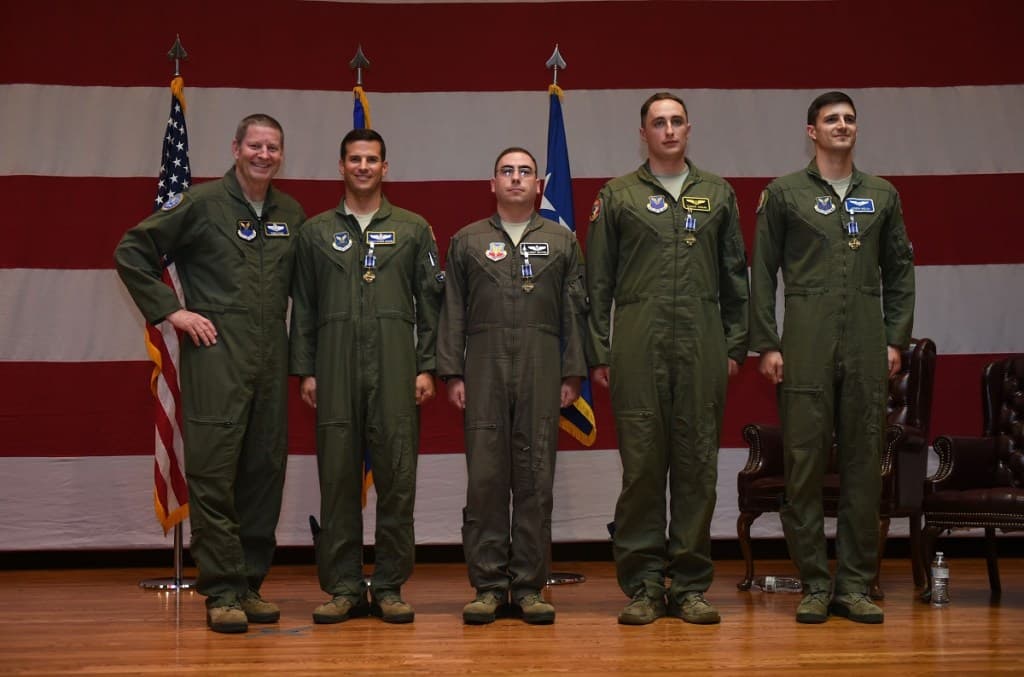
The crew consisted of instructor pilot Maj. Christopher Duhon, weapons system officer instructor Capt. Matthew Sutton, student pilot 1st Lt. Joseph Welch and student weapons system officer 1st Lt. Thomas Ahearn.
Each received the Distinguished Flying Cross at Dyess Air Force Base on July 13, 2018, according to the base’s announcement.
Gen. Robin Rand presented the medals, recognizing the crew’s actions during the emergency. The award honors heroism or extraordinary achievement during aerial flight.
The ceremony recognized both the flying skill that brought the aircraft down safely and the crew’s commitment to getting through the emergency together.
What investigators learned about the seat
The incident also prompted a temporary grounding of the B-1 fleet.
In July 2018, Air Force Chief of Staff Gen. David Goldfein told reporters that a crimped component had prevented the firing signal from reaching the seat when its handles were pulled, Task & Purpose reported.
Goldfein said the system had a second firing pathway, which allowed the aircraft to return to flying while the service pursued technical changes and replacement of the affected parts.
The damaged bomber remained in Midland for almost six months. Following investigation and repairs that made it safe to fly, it departed for Tinker Air Force Base on October 26, 2018, for further maintenance and upgrades.
This article recounts an incident from 2018.