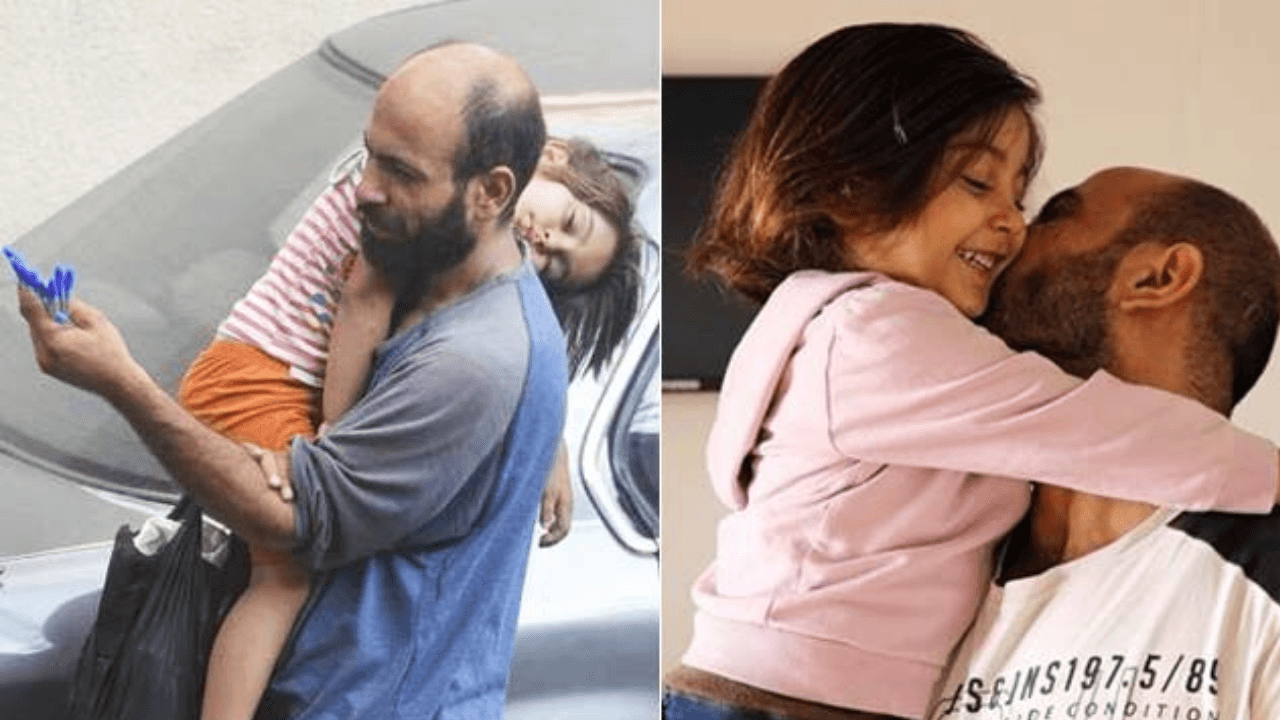
In the summer of 2015, Abdul Halim al-Attar stood on a street in Beirut, Lebanon, holding a handful of blue pens.
His four-year-old daughter, Reem, slept against his shoulder.
He was selling pens to passing motorists, hoping to earn enough to support his children.
Someone photographed the moment. Soon, strangers around the world were searching for the man in the picture.
By the end of the year, al-Attar had opened three small businesses—and provided work for 16 other refugees.
A Father Trying to Support His Children
Al-Attar was a Palestinian-Syrian refugee who had fled the war in Syria.
He came from the Yarmouk area of Damascus, a community devastated by years of conflict.
After leaving Syria, he eventually settled in Beirut with his two children, Reem and her older brother.
Work was difficult to find, and the family struggled financially.
To earn a living, al-Attar sold pens and other small items on the street.
He sometimes brought young Reem along. In the photograph that later spread worldwide, she was sleeping while her father held up pens to potential customers.
The picture showed one ordinary, exhausting moment in the family's daily life.
One Photograph Reached People Around the World
In August 2015, the image caught the attention of Icelandic journalist and web developer Gissur Simonarson, who was based in Norway.
He shared the photograph online and set out to find the father and daughter.
The search gained momentum as social-media users circulated the image and asked how they could help.
Simonarson created the #BuyPens campaign.
He also launched an Indiegogo fundraiser with an initial goal of $5,000.
The photograph resonated with people who had never met al-Attar.
They donated because they wanted to help a father build a safer and more stable life for his children.
The Fundraiser Raised Nearly $191,000
The campaign quickly exceeded its modest original goal.
Over roughly three months, thousands of supporters contributed $188,685, according to contemporary Associated Press reporting.
Later donations raised the reported total to approximately $191,000.
There were complications in transferring the money. Banking arrangements, platform fees and cross-border transactions meant al-Attar did not immediately receive the entire amount.
That distinction is important: the total raised was not the same as cash instantly available to him.
But the support was still enough to create opportunities that had previously seemed far beyond reach.
He Opened a Bakery, Then Two More Businesses
By December 2015, al-Attar had made a remarkable transition.
He had opened a bakery in Beirut.
He then added a kebab shop and a small restaurant.
The businesses operated in the same neighborhood, allowing him to build on the experience and income from his first venture.
Instead of relying on selling small items to passing drivers, he was running businesses that served local customers.
The father once seen carrying a sleeping child while selling pens had become an employer.
Sixteen Other Refugees Found Work
What made the outcome especially meaningful was the help al-Attar offered other displaced families.
According to the Associated Press, his businesses employed 16 Syrian refugees by December 2015.
For people who had fled war and were struggling to find regular employment, those jobs offered an important source of income.
Al-Attar also said he had given about $25,000 to friends and relatives in Syria.
The donations had helped his own family, but he wanted others to benefit too.
He explained that the campaign changed more than his personal circumstances. It also affected his children and people back in Syria.
His Children Finally Had More Room to Grow
The family moved from a cramped living arrangement to a larger apartment in Beirut.
The new home was still modest, situated in an unfinished building near a highway.
But it offered more space and a little more stability.
Reem, the girl sleeping on her father's shoulder in the viral photograph, now had toys and room to play.
Her father could think about the future without depending entirely on each day's street sales.
For a family displaced by war, that change was significant.
The Story Became a Symbol of Human Kindness
The story traveled across international news outlets in late 2015.
Many headlines focused on the dramatic change from selling pens to running businesses.
Yet the story was also about the people who chose to help.
A photograph led one journalist to organize a fundraiser.
Thousands of strangers donated.
And the recipient turned that assistance into businesses that also supported other refugee families.
There is no reliable basis to assume the businesses remained open indefinitely. The documented success described here reflects reporting from late 2015.
A Photograph That Changed More Than One Life
When someone photographed Abdul Halim al-Attar selling pens, they captured a father working to provide for his children.
The person taking the picture could not have known how widely it would travel.
By the end of 2015, the campaign it inspired had raised almost $191,000. Al-Attar was operating three food businesses and employing 16 refugees.
One photograph brought strangers together to help a father. He used that opportunity to help others build a living too.
Editor's note: This article describes events documented in 2015. The figures for donations, businesses and employees reflect contemporary reporting and are not claims about al-Attar's present circumstances.
Sources: Associated Press reporting republished by The Spokesman-Review, December 3, 2015; Al Jazeera — early interview with Abdul Halim al-Attar, August 31, 2015; Deutsche Welle — follow-up, December 4, 2015; The Washington Post — campaign and family background, December 4, 2015; The Independent — fundraising transfer challenges, October 8, 2015.