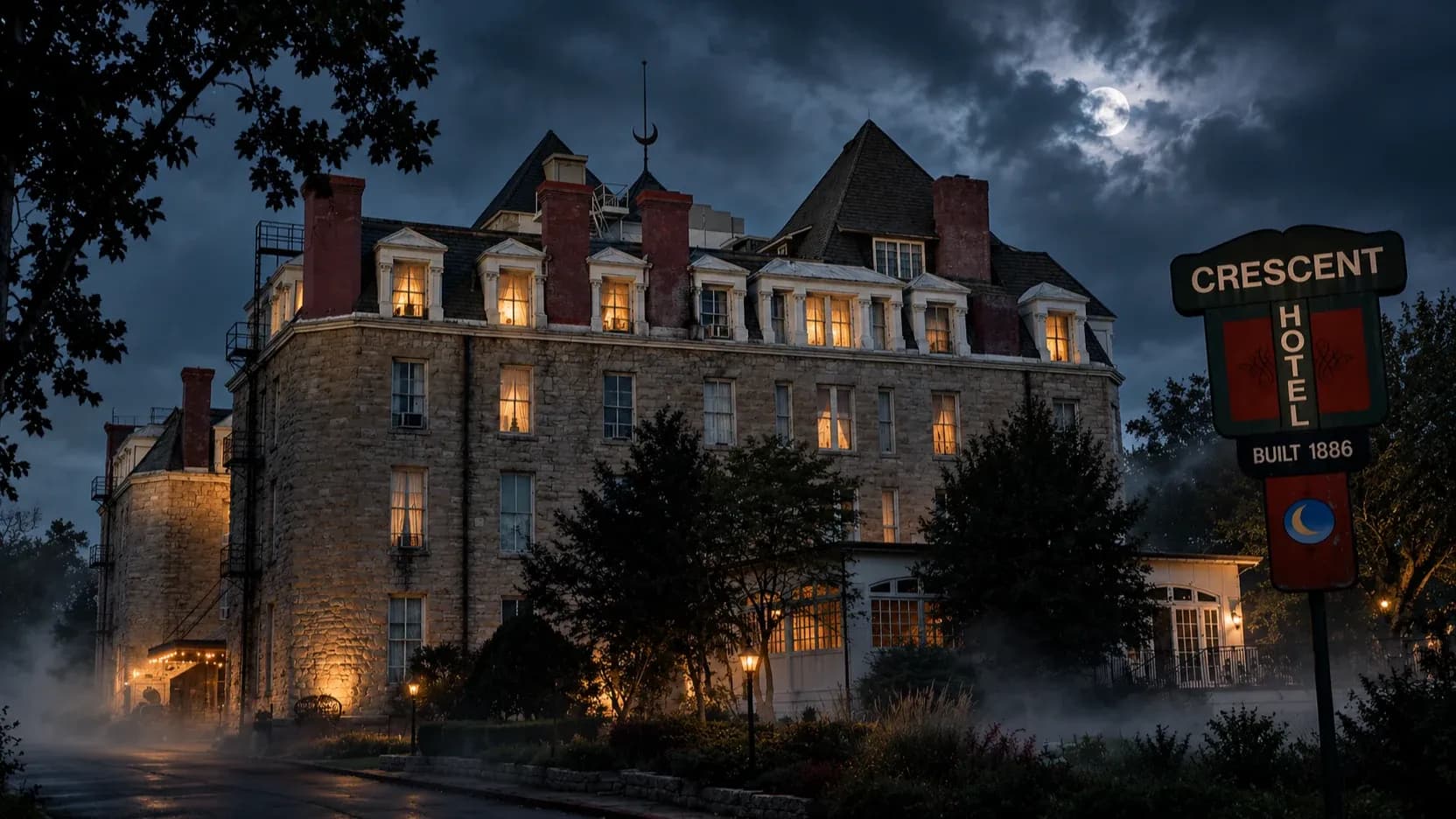
The 1886 Crescent Hotel hides a fraudulent hospital inside one of the Ozarks’ grandest resorts.
Perched above Eureka Springs, Arkansas, the Crescent looks like a stone castle watching over the wooded hills. Guests arrive for its Victorian architecture, mountain views, spa, and famous ghost tours. Yet its darkest chapter involved real patients, false hope, and a man who claimed he could cure cancer.
The building has served as a luxury resort, a school for young women, and Norman Baker’s controversial hospital. Today, stories of apparitions, rolling gurneys, and a ghost called Michael fill its hallways. Some tales have circulated for decades. Others gained new life through television and tourism. The documented history is disturbing enough without treating every legend as fact.
Fast Facts
- 1886Year the hotel opened
- Eureka SpringsArkansas location
- 1938Baker Hospital opened
- 2016Added to the National Register
- OpenCurrent status as a hotel and spa
- 9/10Editorial Creep Factor Score
Source: Encyclopedia of Arkansas, National Register of Historic Places and official hotel information
Why Is the 1886 Crescent Hotel Famous?
The 1886 Crescent Hotel is famous for combining grand architecture with an unusually dark history. It opened as an expensive mountaintop resort before becoming a college and, later, a hospital operated by medical fraudster Norman Baker.
The hotel now calls itself “America’s Most Haunted Hotel.” Nightly tours take visitors through its corridors and into the former hospital morgue. Television appearances, especially a 2005 investigation by Ghost Hunters, helped carry its paranormal reputation far beyond Arkansas.
Unlike many haunted attractions, the Crescent remains a working hotel. Guests can sleep in rooms connected to its best-known ghost stories, including Room 218 and Room 419.
The Story Behind the Legend
A Luxury Resort Above the Ozarks
The Eureka Improvement Company built the Crescent during the rapid growth of Eureka Springs. Travelers had begun visiting the town because local springs were believed to possess healing properties.
Architect Isaac S. Taylor designed the enormous limestone hotel. Irish laborers reportedly cut its stone near the White River. According to the Encyclopedia of Arkansas, the $294,000 hotel opened on May 1, 1886. It offered electricity, elevators, and other luxuries that impressed nineteenth-century visitors.
The building’s heavy masonry, corner tower, balconies, and steep roof created an appearance closer to a European castle than an Ozark hotel. Its architectural and historical importance later earned it a place on the National Register of Historic Places.
From Resort to Women’s College
Tourism weakened during the early twentieth century. In 1908, the property became the Crescent College and Conservatory for Young Women. Students studied subjects that included music, literature, science, and mathematics. The building returned to hotel use during summer vacations.
The college closed in 1924, reopened in 1929, and closed again during the Great Depression. By 1933, the Crescent stood empty. Its most troubling owner soon arrived.
Norman Baker’s Cancer Hospital
Norman Baker purchased the property in 1937 and opened the Baker Hospital and Health Resort in 1938. Baker presented himself as a medical authority, although he had no medical training.
His advertisements promised that cancer could be cured without surgery or radiation. Desperate patients traveled to Eureka Springs and paid for his treatment. One formula contained alcohol, glycerol, carbolic acid, watermelon seed, corn silk, and clover leaves. It offered no proven cure.
Baker used radio broadcasts and mailed promotional material to attack established medicine while advertising his hospital. A federal court convicted him of mail fraud in 1940. The hospital closed, and Baker later served time in federal prison. A detailed Smithsonian account of Norman Baker describes how he turned suffering and distrust into a profitable business.
Historical sources do not establish how many patients died at the Crescent. Claims that Baker murdered patients or secretly buried bodies on the property are also unsupported. His documented deception, however, caused seriously ill people to spend money and time on a useless treatment.
The Bottles Beneath the Grounds
In February 2019, landscaping work uncovered a buried collection of medical containers behind the hotel. The Arkansas Archeological Survey helped excavate hundreds of bottles and jars associated with the hospital period.
Some containers held liquids, powders, pills, or preserved tissue specimens. Archaeologists also recovered medical equipment and damaged film marked with words connected to Baker’s treatment. The 2019 excavation report confirmed that the hospital left a physical record beneath the grounds.
The discovery supported the history of Baker’s medical displays and promotional operation. It did not prove that supernatural activity occurred or that victims were secretly buried there.
Why People Think It’s Haunted
The Crescent’s best-known spirit is Michael, described as an Irish stonemason who fell during construction. Hotel folklore connects him with Room 218, where guests report footsteps, doors moving, and unseen hands. The fatal fall and Michael’s identity have not been firmly established through accessible historical records.
Room 419 is associated with Theodora, said to be a former hospital patient or employee. Guests claim that belongings have moved and that a woman has appeared near the room. Another story describes a nurse pushing a gurney along the third-floor corridor.
Visitors also report a small child in the halls, a woman falling from a balcony, and shadowy figures near the former morgue. These are witness stories and hotel folklore, not verified evidence of ghosts.
Ghost Hunters investigated the hotel in 2005. Its team recorded a human-shaped thermal image in the morgue and presented it as unexplained. The episode increased national interest, but a television recording cannot establish the identity or supernatural nature of a figure.
Fact Vs Fiction
Some stories about the 1886 Crescent Hotel come from documented history. Others developed through folklore, television, and visitor retellings.
| Label | What the evidence shows |
|---|---|
| Fact | The Crescent opened in 1886 as a luxury resort built by the Eureka Improvement Company. |
| Fact | Norman Baker operated a fraudulent cancer hospital and was convicted of mail fraud in 1940. |
| Fact | A 2019 excavation uncovered hundreds of medical bottles and artifacts from the hospital period. |
| Fiction | Historical records do not confirm that named spirits such as Michael and Theodora haunt specific rooms. |
| Fiction | The buried medical jars do not prove that Baker murdered or secretly buried patients at the hotel. |
Can You Visit the 1886 Crescent Hotel Today?
Yes. The Crescent is an operating hotel, spa, restaurant destination, wedding venue, and historic attraction at 75 Prospect Avenue in Eureka Springs. Visitors can stay overnight or reserve one of several paranormal programs.
Ghost tours run nightly, subject to availability. Options include the standard hotel tour, a children’s tour, an expanded late-night experience, and a midnight investigation. Tours visit historically significant areas, including the former morgue.
At publication, standard tickets start at $29.50 for adults and $15 for children aged 12 or younger. Specialty experiences generally cost between $35 and $39.50. Schedules and prices can change, so check the hotel’s official visitor information before traveling.
Creep Factor Score: 9/10
Rating: Nightmare Fuel
| Category | Editorial score |
|---|---|
| Historical Darkness | 8.5/10 |
| Paranormal Reputation | 9/10 |
| Atmosphere | 9/10 |
| Horror Fame | 8.5/10 |
| Visitor Experience | 9.5/10 |
How We Calculated This Score
This editorial score reflects the hotel’s documented hospital history, castle-like atmosphere, national paranormal reputation, television exposure, and unusually strong visitor access. The nightly tours, overnight stays, former morgue, and surviving Baker artifacts create a compelling experience even when the ghost stories are treated as folklore.
Is the 1886 Crescent Hotel Worth Visiting?
The Crescent is worth visiting even if you have no interest in ghosts. Its limestone architecture, mountaintop location, and changing roles tell an unusual story about tourism, education, medicine, and preservation.
Paranormal fans receive more than a staged haunted-house experience. They can explore the setting where the legends developed and examine artifacts from Baker’s hospital. History lovers may find the documented story more unsettling than the supernatural claims.
The hotel openly uses its haunted reputation as part of its business. Still, its strongest tours connect folklore to real history and make clear where evidence ends. That balance makes the Crescent one of America’s most compelling haunted hotel destinations.
Frequently Asked Questions
Is the 1886 Crescent Hotel really haunted?
Guests and staff report unexplained experiences, but no scientific evidence proves that ghosts inhabit the hotel. Its haunted status remains folklore.
What happened at the Crescent Hotel?
It opened as a resort, became a women’s college, and later housed Norman Baker’s fraudulent cancer hospital before returning to hotel use.
Did Norman Baker cure cancer?
No. Baker had no medical training, and his treatment was not an effective cancer cure. He was convicted of mail fraud in 1940.
Can visitors enter the former morgue?
Yes. The former morgue is included in selected guided ghost tours and paranormal experiences. Access depends on the tour and current schedule.
What television show investigated the Crescent Hotel?
Ghost Hunters featured the Crescent in a 2005 episode. Other paranormal television productions have also visited the property.