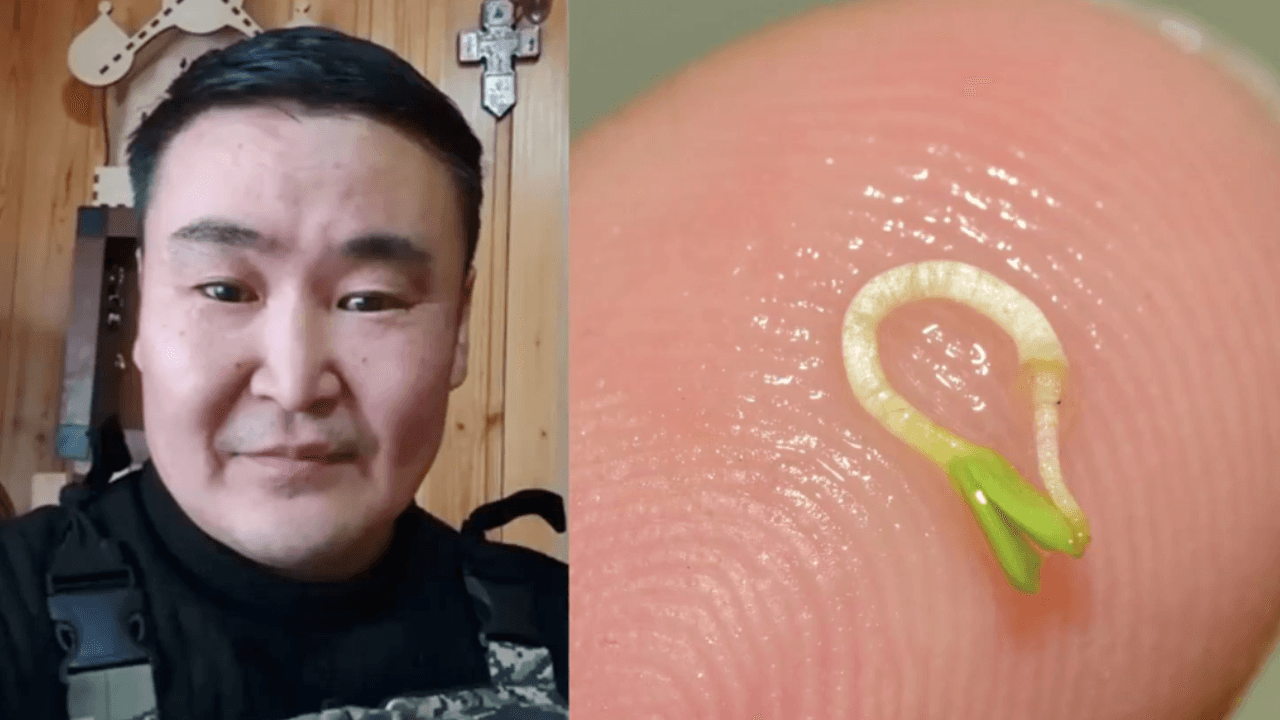
For four months, Maxim Sleptsov struggled with headaches, eye irritation and worsening vision.
The 42-year-old man from Russia's Sakha Republic could trace the trouble to a summer trip when a tree branch struck his face.
He thought he had removed the debris from his eye. But the discomfort never fully disappeared.
When specialists finally examined him in Yakutsk, they discovered something extraordinary: a tiny plant seed had germinated in the tissue covering the white of his eye.
Its root had grown about three millimeters long.
A Branch Struck His Eye During a Summer Trip
Sleptsov was visiting a friend in the remote Abyysky district of Siberia when a branch whipped across his face.
He had been spending time outdoors, fishing and picking berries.
The impact left his eye red, watery and painful.
He rinsed it and removed what appeared to be a small piece of bark.
For a time, he believed that had solved the problem.
But a tiny seed apparently remained lodged in the delicate tissue of his eye.
The Headaches Continued for Four Months
The following months were increasingly uncomfortable.
Sleptsov experienced recurring headaches, pressure around the eye and the persistent feeling that something was stuck inside it.
He later told regional reporters that he was waking up with headaches almost every day.
His vision also worsened, and reports described episodes of double vision.
He tried to remove the irritating object himself, but doing so was painful.
According to local coverage, an earlier medical examination had failed to identify the foreign material.
The distance to specialized eye care added another complication. Parts of the Sakha Republic are extremely remote, and patients may have to travel hundreds of kilometers for treatment.
Doctors Found a Seed That Had Sprouted
Sleptsov eventually sought treatment at an emergency ophthalmology center in Yakutsk.
This time, doctors identified the source of the irritation.
A small seed had become embedded in the conjunctiva, the thin tissue covering the white part of the eye and lining the eyelids.
The seed had begun germinating.
More remarkably, a small root extended into the conjunctival tissue.
Chief physician Ivan Lutskan described the discovery as highly unusual.
But the medical finding needs to be understood accurately: the seed was in the surface tissue of the eye. A fully developed plant was not growing deep inside the eyeball.
The Root Was About Three Millimeters Long
Ophthalmologist Elizaveta Karpova performed the procedure to remove the foreign material.
She used local anesthesia and an injection needle to carefully extract the germinated seed.
The root measured approximately three millimeters, according to the doctor's account.
That is less than one-eighth of an inch.
Some sensational descriptions of the case have suggested the root extended nearly an inch into the eye. The reported medical measurement does not support that claim.
Karpova said she had never encountered a similar case in her practice.
He Reported Relief After the Seed Was Removed
The procedure was successful.
According to regional reporting on October 27 and 28, 2026, Sleptsov experienced relief soon after the seed was taken out.
He said he was finally waking up without the headaches that had troubled him for months.
Doctors also reported that his eye was no longer facing an immediate threat from the foreign object.
Karpova warned that leaving the material in place could have caused serious complications, including a corneal ulcer and potential vision loss.
His case was shared in regional news coverage and soon attracted international attention.
How Can a Seed Germinate in Eye Tissue?
Seeds can begin to germinate when they encounter sufficient moisture and suitable environmental conditions.
In Sleptsov's case, doctors reported that the seed remained lodged in moist conjunctival tissue long enough to produce a small root.
That does not mean an eye can support the normal growth of a mature plant.
The reported finding was a germinated seed with a very short root, not a tree, flower or other fully formed plant.
The exact type of seed was not identified in the public reports reviewed.
This appears to have been an unusual medical event rather than a common consequence of eye injuries.
Why Injuries From Branches Can Be Dangerous
Even when an eye injury seems minor, plant material can introduce a foreign object or cause damage that is difficult to see without specialized equipment.
Scratches from branches and leaves may also introduce bacteria or fungi.
The U.S. Centers for Disease Control and Prevention warns that fungal keratitis, an infection of the cornea, can develop after eye injuries involving plant material.
Symptoms may include pain, redness, blurred vision and sensitivity to light.
Anyone experiencing persistent pain, a foreign-body sensation or a change in vision after an eye injury should seek prompt medical assessment.
Rubbing the eye or trying to dig out an embedded object can make an injury worse.
A Tiny Seed Caused Months of Pain
The most surprising part of Sleptsov's experience was not the size of the object doctors removed.
It was how much discomfort a seed only a few millimeters across had caused.
For months, he lived with headaches and declining eyesight without knowing what remained in his eye.
Once specialists found and removed the seed, he finally reported relief.
A branch struck his eye during an ordinary summer outing. Four months later, doctors discovered that a tiny seed had begun putting down roots.
Editor's note: This report is based on statements from the Yakutsk ophthalmology hospital and regional coverage published in October 2026. The root was reported to be approximately 3 mm long. The seed was embedded in conjunctival tissue, not growing as a mature plant inside the eyeball.
Sources: Yakutsk regional reporting — October 27, 2026; Regional report citing Yakutsk ophthalmology hospital — October 28, 2026; TOP24 — statement from the hospital's chief physician; Health Chosun — medical account, October 30, 2026; CDC — About Fungal Keratitis.